


Judgment axis | Key judgment |
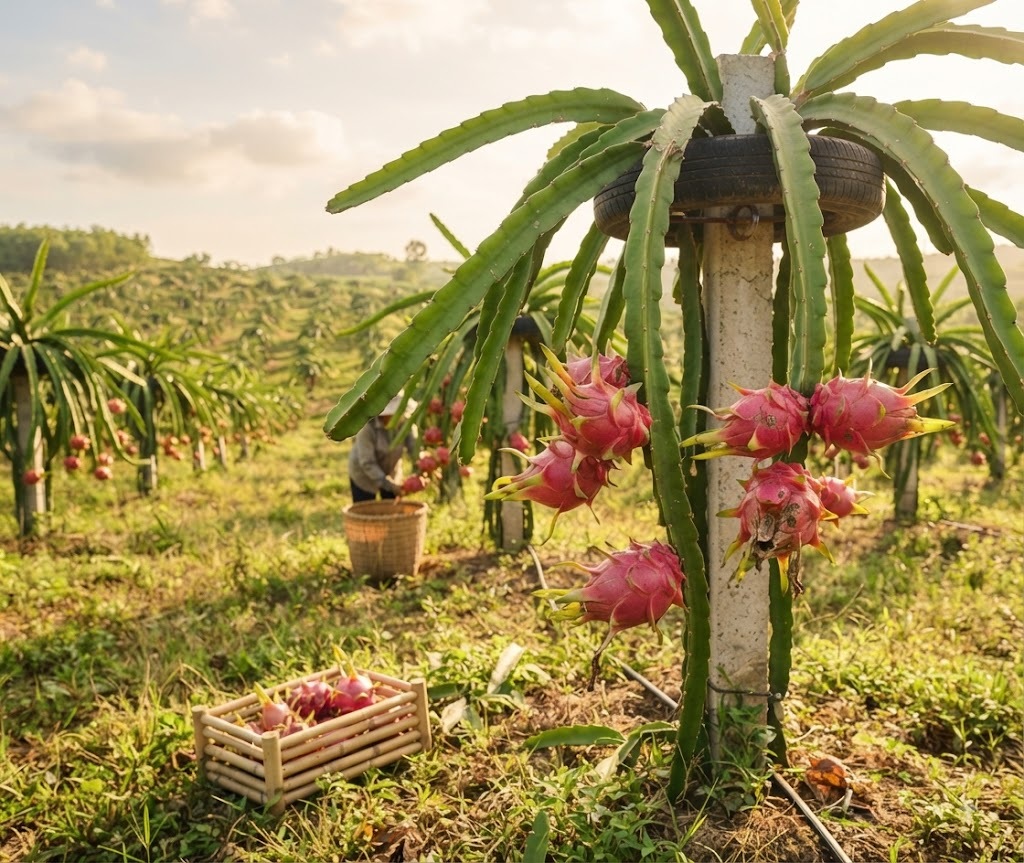
| Item Identity | The tropical and subtropical fruit group of the Cactaceae family, where the Rural Development Administration's Nongsaroo identifies the plural Hylocereus Species as dragon fruit ( Nongsaroo ) |
| Key role | Domestic facility-grown fresh and premium fruits, and raw materials for frozen foods, purees, beverages, and desserts |
| Harvesting principle | Separation of harvest lots based on Species, Cultivar, Skin Color, Flesh Color, Coloration, and Buyer Application |
| Product separation | Manage white, red, and yellow fresh fruits, sliced fruits, frozen fruit pulp, purees, juices, jams, jellies, etc. as individual products. |
| Separation of similar items | Multiple Species and Color Systems are not integrated into the same variety |
| Domestic statistics | Nationwide cultivation area and production volume of dragon fruit alone: To be entered after verification of official raw data. |
| Domestic cultivation base | The Rural Development Administration cited dragon fruit as a representative subtropical fruit cultivated domestically and included it among the five subtropical fruits targeted by the 2026 heating energy forecast system. ( Rural Development Administration ) |
| Flowering and Harvesting Characteristics | Nongsaroo explains that flowering begins in early June, with 3 to 4 blooms per year, and that harvesting is possible approximately 35 to 37 days after flowering. This is a general reference value from the 2021 technical data. ( Nongsaroo ) |
| Processing role | Nongsaroo suggests the potential for utilizing not only fresh fruit but also jam, jelly, juice, and wine. ( Nongsaroo ) |
| Safety Management | The Ministry of Agriculture, Food and Rural Affairs' PLS data indicates that registered pesticides exist on dragon fruit, and specifies that safe usage standards should be checked through the latest Pesticide Information Service. ( Ministry of Agriculture, Food and Rural Affairs ) |
| Supply and demand risk | Facility heating, flowering, pollination, fruit setting, variety mixing, ripeness variation, storage loss, import competition |
| Operating Principles | Species–Cultivar–Flesh Color–Facility–Flowering–Harvest–Product–Lot–RFQ Connection |
| Final goal | Separate domestic facility production and imported/processed raw materials by product, and feed back delivery and repurchase results into the production plan |
Basic fields | detail |
| Korean name | Dragon fruit |
| English name | Dragon Fruit / Pitaya |
| Representative scientific name | Default representative value Hylocereus undatus (Haworth) Britton & Rose; Species verification is mandatory for the actual Product ( Nongsaroo ) |
| classification | Cactaceae |
| Edible parts | The edible part of a mature fruit, including the flesh and seeds. |
| Non-edible · Separate management | The peel, stem, flower, and root are separated from the general fruit product. |
| Major harvesting stages | Immature fruit → Fruit starting to color → Fruit ripe for harvest → Fruit fully ripe for raw consumption → Fruit for processing |
| Basic product form | Fresh fruit, sliced fruit, frozen fruit pulp, puree, juice, jam, jelly, dried fruit, powder |
| Basic processing stage | Sorting, washing, peeling, cutting, freezing, crushing, pureeing, juicing, heating, drying |
| Basic use | Raw Food · Salad · Cafe · Beverages · Desserts · Bakery · HMR · PB |
| Principle of similar items | Accurately distinguish between white, red, pink, yellow, and other species |
Nongsaroo presents Hylocereus undatus, H. costaricensis, H. monacanthus, and H. megalanthus as the scientific names for dragon fruit, explaining that while white-fleshed varieties are widely cultivated in Korea, red and pink-fleshed varieties also exist. ( Nongsaroo )
Product Master
Product ID | Actual product form | Key Management Standards |
| DRAGON-P01 | Domestic facility raw materials | Species · Cultivar · Facility · Harvest Date |
| DRAGON-P02 | White meat raw fruit | Skin color, white flesh, weight, ripeness |
| DRAGON-P03 | Red meat raw fruit | Species/Cultivar · Red flesh · Color |
| DRAGON-P04 | Pink fresh fruit | Flesh color, variety, ripeness, appearance |
| DRAGON-P05 | Yellow dragon fruit | Species · Skin Color · Thorns · Variety Verification |
| DRAGON-P06 | Premium small packaging | Appearance, uniformity, weight, ripeness |
| DRAGON-P07 | Cut dragon fruit | Peeling, cutting standards, hygiene, microorganisms |
| DRAGON-P08 | Frozen dragon fruit flesh | Raw Material Lot, Freeze, and Thaw Quality |
| DRAGON-P09 | Frozen red meat pulp | Color stability after freezing and thawing |
| DRAGON-P10 | Dragon fruit puree | Flesh color, particle size, seeds, color |
| DRAGON-P11 | Dragon fruit juice ingredients | Juice/Puree Form/Buyer Standard |
| DRAGON-P12 | Jam and Jelly | Flesh, blend, viscosity, color |
| DRAGON-P13 | Drying and freeze-drying | Moisture, shape, color, packaging |
| DRAGON-P14 | Powdered raw materials | Particle size, moisture, color, microorganisms |
| DRAGON-P15 | PB · Finished Products | Ingredient Traceability, Labeling, and Use-by Date |
Classification criteria | Subdivision type | Management principles |
| Plant classification | Dragon Fruit/Pitaya | Top Crop Master |
| Species | H. undatus·H. costaricensis·H. monacanthus·H. megalanthus, etc. | Separate Species ID |
| Cultivar | actual cultivated varieties | Variety ID |
| flesh color | White, Red, Pink, Others | Required Product Attribute |
| Skin color | Red and yellow tones, etc. | Connect with Species/Cultivar |
| Harvesting stage | Immature · Coloring Begins · Ripe · Fully Ripe | Harvest Stage |
| Cultivation method | Facilities and other actual cultivation methods | Facility connection |
| production site | Domestic/Imported | Origin separation |
| Distribution methods | Fresh fruit · Small packaging · Fresh-cut · Frozen | SKU separation |
| Processing form | Puree, Juice, Jam, Jelly, Dried, Powder | Product ID |
| Final use | Raw Food · Cafe · Dessert · Beverage · HMR · PB | Buyer Specification |
| Transaction type | Spot products · Regular supply · Contract farming · Import · OEM/PB | Contract NDA |
step | Essential Dataset | Management purpose |
| Cultivation plan | Species · Cultivar · Flesh Color · Area · Buyer Use | Production plan |
| Seedlings and cuttings | Variety · Mother Plant · Cutting Source | Variety Tracking |
| formula | Official Date, Facilities, and Planting Information | Production history |
| Landlords and Inducements | Landlord, abbot, and prisoner | Work and Quantity Management |
| New shoot management | New shoots, training, pruning | Flowering and fruit setting |
| Facility Environment | Temperature, humidity, sunlight, ventilation | Growth stability |
| rising | Outside temperature, rainfall, sunshine | Risk Management |
| heating | Settings, Operating Time, Fuel | Energy economics |
| Watering | Watering amount and frequency | Growth and quality |
| dispute | Fertilizer, Input Amount, Timing | Production history |
| flowering | Flowering date, number of flowers, number of blooms | Harvest forecasting |
| moisture | Natural, artificial, and pollination | Fruit set management |
| Fruit set | Number of fruits set · Fruit set rate | Production volume forecast |
| pests | Occurrence, Control, and Pesticides | Quality and Safety |
| Harvest judgment | Skin color, days, ripeness, Buyer's purpose | Harvesting at the right time |
| harvest | Date, Time, Weight | Raw Lot |
| Selection | Color, Size, Damage, Ripness | Grade separation |
| Pre-cooling | Time and temperature | Leading management |
| cold storage | Storage conditions/period | Fresh Supply |
| purifying | Cleaning and hygiene | Preprocessing |
| peeling | Peeling yield/loss | Fresh-cut |
| cutting | Standards, hygiene, and microorganisms | HMR · Dining Out |
| freezing | Freezing and storage | Frozen Product |
| Crushing and Puree | Input and Output | Processing Yield |
| Juicing | Raw materials and yield | Beverage |
| Jam and Jelly | Mixing, heating, and filling | Finished Product |
| dry | Drying conditions · Moisture | Dried Product |
| smash | Particle size and moisture | Powder |
| packaging | By product type | circulation |
| shipment | Buyer · Lot · Delivery Date | Delivery |
Quality items | Fresh fruit | Cut and frozen products | processed goods | finished product | Public rating |
| Species | essential | succession | succession | tracking | Public/Verified |
| Cultivar | essential | succession | Raw material standards | tracking | Verified |
| flesh color | essential | essential | core | Product Standards | Public/Verified |
| mountainous district | essential | succession | succession | tracking | Public |
| Facilities and types of cultivation | essential | succession | tracking | - | Verified |
| producer | ID | succession | tracking | tracking | Verified |
| Lot | essential | new | new | new | Verified/NDA |
| Flowering day | record | succession | tracking | - | Verified |
| Harvest day | essential | succession | succession | tracking | Verified |
| Skin color | core | Raw Material Evaluation | Color management | tracking | Member |
| flesh color | Variety · Product Core | core | core | Product specifications | Verified |
| appearance | core | Raw material inspection | The relevant city | Product Standards | Member |
| weight | Individuals/Packaging | input | Output | Display amount | Member |
| size | Buyer specifications | Cutting specifications | Raw material standards | Product Standards | Member |
| Sukdo | core | Fabrication aptitude | Raw material standards | tracking | Verified |
| hardness | Fresh fruit quality | Amputation aptitude | - | - | Verified |
| Damage/Deterioration | test | eliminate | Non-conformity exclusion | management | Verified |
| pests | check | tracking | tracking | - | Verified |
| alien substance | check | essential | essential | essential | Verified |
| pesticide residues | Legal standards | succession | check | Legal standards | Verified/NDA |
| microorganism | If necessary | core | core | Product Standards | Verified/NDA |
| Peeling yield | - | core | Cost linkage | - | NDA |
| pulp yield | specimen | core | Cost linkage | tracking | NDA |
| Freezing history | - | essential | succession | tracking | NDA |
| Color | Standards by flesh color | core | Puree Essentials | Product Standards | Verified |
| Puree yield | - | input | core | Cost linkage | NDA |
| Processing history | - | corresponding | essential | essential | NDA |
| packaging | Fresh fruit | Fresh-cut/Frozen | By product | Labeling packaging | Member |
| save | cold storage | Refrigeration/Freezing | By product | By product | Verified |
| Expiration date | Test-based | Test-based | setting | mark | Verified |
| Shipment | record | record | record | record | Verified |
| Returns and Claims | record | record | record | record | NDA |
| Repurchase | connection | connection | connection | connection | NDA |
The Ministry of Agriculture, Food and Rural Affairs' PLS data for dragon fruit specifies that necessary pesticides were registered as of 2019, advising users to reconfirm registration status and safety usage standards through the Pesticide Information Service or Nongsaroo for actual use. Therefore, the list of previously registered pesticides will not be automatically applied to the 2026 Lot. ( Ministry of Agriculture, Food and Rural Affairs )
Lot Master Required Field
Lot ID · Item · Product Type · Species · Representative Scientific Name · Cultivar · Skin Color · Flesh Color · Cultivation Type · Origin · Facility · Producer · Seedling · Cutting Source · Planting Date · Flowering Date · Flowering Cycle · Pollination Method · Fruit Set Date · Harvest Date · Harvest Time · Harvest Purpose · Skin Color · Flesh Color · Ripness · Hardness · Weight · Specifications · Grade · Pests & Diseases · Appearance Check · Pesticide Usage Records · Pesticide Residue · Microbial Test Report · Pre-cooling · Refrigeration · Freezing History · Raw Material Lot · Processing History (Peeling · Cutting · Puree · Juicing · Jam · Drying · Powder) · Packaging Date · Best Before Date · Shipper · Returns · Claims · Repurchase
Customers | Purchase criteria | Cooperation opportunities |
| Domestic dragon fruit farms | Species · Variety · Flesh Color · Harvest Period | contract farming |
| Agricultural cooperatives and production organizations | Flesh color, weight, ripeness, and grade | Joint screening |
| Fresh produce and specialized distribution | Appearance, size, color, and line | Premium domestic |
| Large-scale distribution | Uniformity, Origin, Safety | Small packaging · Private label |
| Online/Direct Transaction | Domestic · Ripeness · Delivery Durability | Direct from the farm |
| importer | Origin·Species·Variety·Quarantine | Import RFQ |
| Hotel Buffet | Fresh fruit · Fresh-cut · Color | Premium Supply |
| Cafes · Drinks | red meat, puree, frozen meat | Beverage RFQ |
| Bakery · Dessert | Flesh color, puree, and cut pieces | Product Development |
| Salad · HMR | Fresh-cut · Ripeness · Hygiene | Regular supply |
| Ice cream and dairy products | Puree, frozen fruit pulp, color | Ingredient RFQ |
| Juice manufacturer | Fruit flesh color, puree, and juice specifications | B2B raw materials |
| Jam and Jelly Companies | Red flesh, color, and processing yield | Processing RFQ |
| dried food companies | Suitable for drying and freeze-drying | Dried Product |
| PB·OEM | Beverages, desserts, and processed foods | Manufacturing cooperation |
| Research and technology institutions | Species · Facilities · Moisture · Storage · Processing | Joint demonstration |
step | Key variables | Operational judgment |
| Domestic facility production | Species · Varieties · Flesh Color · Crop Conditions | Local Supply |
| Overseas production | Country · Species · Variety · Crop Status | Import Supply |
| Contract farming and procurement | White meat/Red meat · Fresh fruit/For processing | Buyer Plan |
| harvest | Color, Ripeness, and Harvest Date | Product Branch |
| Selection and Pre-cooling | Appearance, Weight, Temperature | Fresh Supply |
| cold storage | Lead Time · Inventory | Fresh fruit distribution |
| Import and Customs Clearance | Origin·HS·Quarantine | Import Lot |
| Fresh-cut | Peeling, cutting, hygiene | Foodservice |
| freezing | Freeze/Inventory | Year-round supply |
| Puree · Juice | Color, Yield, and Specifications | Processor RFQ |
| Jam, Jelly, Dried | Processability and Yield | PB/OEM |
| Distribution and supply | Refrigeration, Freezing, Delivery Time | Buyer rating |
| RFQ · Repurchase | Quality, Price, Claims | Repeat trading |
Import and export management
item | Management principles |
| HS Code | Current HS verification by the Korea Customs Service for each product, such as fresh dragon fruit, frozen fruit, puree, juice, and jam |
| Freshness and import volume | Input after verification of raw data from the Korea Customs Service's import and export trade statistics. |
| Import volume of frozen and processed food | Input after official verification of raw data |
| Revenue | Input after official verification of raw data |
| Export volume and value | Input after official verification of raw data |
| major countries | Enter after verifying the raw data for the official country, quantity, and amount by HS code. |
| Quarantine | Check fresh fruit plant quarantine requirements by country |
| FTA | Check agreement tariff rates by origin and HS code |
| PLS | Application of pesticide residue standards to domestic and imported agricultural products |
| Food safety | Check standards by form, such as fresh-cut, frozen, and puree. |
| cold chain | Fresh, sliced, and frozen fruit separate Runtime |
Products and processes | Key conditions | RFQ conversion |
| Raw materials from the source | Species·Cultivar·Flesh Color·Ripeness | Raw RFQ |
| White meat raw fruit | Appearance, Weight, and Ripness | Fresh RFQ |
| Red meat raw fruit | Color, ripeness, variety | Premium/Processing RFQ |
| Yellow fresh fruit | Species · Varieties · Color · Thorns | Specialty RFQ |
| Fresh-cut | Peeling, cutting, microorganisms | HMR · Hotel |
| frozen fruit flesh | Freezing, Thawing, Color | Frozen RFQ |
| Red meat, frozen flesh | Color and freeze stability | Beverage/Bakery |
| Puree | Particle size, seeds, and color | Beverage |
| Extraction and juice ingredients | Yield, Color, Scent | Juice RFQ |
| jam | flesh, color, viscosity | OEM/PB |
| jelly | Color, Solids, Mixing | Confectionery |
| Dried dragon fruit | Moisture, Tissue, Color | Snack |
| freeze-dried | Color, shape, moisture | Premium Ingredient |
| powder | Particle size, color, moisture | Food Ingredient |
| Non-commercial products and | Appearance defects and safety | Processing conversion |
| pericarp | Separated from regular fruit pulp product | The commercialization of pigments and extracts as materials is subject to verification of official grounds. |
| Stems and pruning products | Separating fruits from the supply chain | Compost, materials, etc. will be reviewed separately. |
Nongsaroo introduces that dragon fruit can be utilized in the form of jam, jelly, juice, and wine, in addition to being consumed fresh. Therefore, a Product Research Profile must evaluate not only freshness and quality but also flesh color, yield, color stability, and suitability for processing products . ( Nongsaroo )
Product Research Profile (PRP)
PRP area | Key question |
| Species | What are the actual dragon species? |
| Cultivar | Did you accurately distinguish between white-fleshed, red-fleshed, and yellow varieties? |
| flowering | What is the relationship between the annual number of flowering cycles and yield? |
| moisture | What are the characteristics of self-pollination and cross-pollination, and the necessity of artificial pollination, by variety? |
| harvest | What is the relationship between days after flowering, skin color, and the optimal harvest time? |
| flesh color | What is the color and color range required by the buyer? |
| Artificiality rate | What is the actual flesh yield relative to the original fruit? |
| Fresh-cut | What are the quality and microbial stability after peeling and cutting? |
| freezing | How do the color, texture, and drip change after thawing? |
| Puree | What are the processing yields and color stability by variety? |
| juice | Which juicing or puree method meets the buyer's requirements? |
| dry | Is the color and texture maintained after drying? |
| Buyer | How do flesh color, species, and product shape affect repurchase? |
first of all | Execution item | Performance indicators |
| 1 | Species·Cultivar·Flesh Color·Facility·Harvest Date·Lot made mandatory | Required value completion rate |
| 2 | Separation of White Meat, Red Meat, Yellow Meat, Fresh Fruit, Frozen, and Puree Products | Product identification rate |
| 3 | Facility environment, flowering cycle, pollination, fruit set, and harvesting link | Growth history connection rate |
| 4 | Datafication of quality, certificates, pre-cooling, freezing, and processing history | Traceability rate |
| 5 | Farm–Importer–Processor–Buyer RFQ Connection | RFQ Match Rate |
| 6 | Video AI screening for peel color, size, and damage | Automatic judgment accuracy |
| 7 | Video AI Flesh Color Product Classification | Color classification accuracy |
| 8 | Flowering and harvest time prediction | Prediction error |
| 9 | Fruit set and yield prediction | Error compared to actual |
| 10 | Optimization of facility heating energy | Energy cost per kg |
| 11 | Prediction of maturity and release time | Returns and Overripe Rates |
| 12 | Fresh-cut quality prediction | Waste rate and expiration date compliance rate |
| 13 | Puree and Processing Yield Prediction | Error compared to actual |
| 14 | AI Supplier/Buyer Match | Sample→Contract Conversion Rate |
| 15 | Traceability | Seedling/Import Lot → Finished Product Traceability |
Problem group | Problem Definition | Required data |
| Mixed Species | Various species are mixed under the product name "dragon fruit." | Scientific name · Species |
| Mixed varieties | Distribution without Cultivar information | Variety |
| Mixed flesh colors | Trading white meat and red meat as the same product | Flesh Color |
| Variation in flowering order | Differences in yield and work distribution due to continuous flowering | Flowering Cycle |
| Moisture instability | Moisture characteristics by variety not reflected | Pollination |
| Facility heating costs | Energy costs of subtropical facility fruit trees | Climate·Energy |
| Fluctuation in production volume | Effects of flowering, pollination, and facility environment | Growth·Yield |
| Variation in harvest maturity | Discrepancy in standards for flowering date and peel color | Harvest Data |
| Size and grade deviation | Differences in fruit weight by farm and variety | Lot Quality |
| freshness deterioration | Quality changes during the distribution process | Temperature·Time |
| Fresh-cut microorganisms | Safety after peeling and amputation | Microbiology |
| Frozen quality | Changes in texture and color after thawing | Freeze/Thaw |
| Red meat color stability | Color change after puree, freezing, and heating | Color Data |
| Puree yield variation | Yield differences by species and maturity level | Input/Output |
| Domestic and Import Competition | Differences in Price, Freshness, and Lead Time | Origin·Price |
| Dispersion of test reports | Pesticides/Microorganisms and Lot Unconnected | Certificate |
| Mixed HS/Product | Confusion over statistics regarding fresh, frozen, and puree | HS Description |
| Repurchase not reflected | Buyer evaluation not linked to selection of next variety/farm | Evaluation·Reorder |
RFQ Type | Public Registration | Verify/NDA |
| Domestic dragon fruit procurement from production areas | Species · Flesh Color · Region · Period | Farm, Volume, Unit Price |
| Selling fresh white meat | Variety, Weight, Ripeness | Lot · Price |
| Selling fresh red meat | Variety, Color, Weight | Lot · Price |
| Yellow dragon fruit | Species · Varieties · Product Types | MOQ · Unit Price |
| purchase | Product · Required Specifications | Physical quantity and price |
| Regular supply | Flesh color · Delivery cycle | Contract terms |
| contract farming | Species·Cultivar·Flesh color | Farms, Area, Unit Price |
| Facility cultivation cooperation | Facility and Production Targets | Heating and production costs |
| Fresh-cut | Cutting standards and hygiene | Microorganisms and expiration dates |
| Frozen fruit pulp | Flesh color and freezing standards | Lot · Report |
| Puree | Color, particle size, and seeds | Yield · MOQ |
| Juice ingredients | White meat/Red meat · Standard | Price/Test Report |
| Jam and Jelly | Color, Viscosity, and Mixing | OEM conditions |
| Drying and freeze-drying | Moisture, color, and specifications | MOQ · Price |
| Dining & Hotel | Fresh-cut | Delivery time/Unit price |
| Cafes · Drinks | Red meat puree · frozen meat | Regular delivery |
| HMR·PB | Beverages, Jelly, Desserts | Manufacturing conditions |
| import | Origin·Species·Product | Quarantine · Importer · Price |
| Technology demonstration | Heating, Moisture, AI Sorting, Storage | Facilities and test conditions |
| Research cooperation | Species · Flesh Color · Processing | Dataset·IP |
① Need Products & Materials
Companies and institutions seeking necessary products, agricultural products, raw materials, and processed goods register purchasing demands. Registered requests are utilized to review cooperation with potential suppliers and producers based on the RFQ Intelligence Library.
Process:
RFQ Registration → Supplier/Product Review → Collaboration Connection → Future AI Matching
Register
② We are looking for production and manufacturing partners. (Need Suppliers & Manufacturers)
Register a request to find necessary production and supply partners, ranging from farms and producer organizations to processing companies, OEM, ODM, and private label manufacturers.
Process:
RFQ Registration → Review of Production & Manufacturing Capabilities → Collaboration Connection → Future AI Partner Matching
Register
③ We are looking for domestic and international buyers. (Need Buyers)
Farmers, producer organizations, and manufacturing companies are requesting cooperation with new buyers, such as domestic and international distributors, importers, brand companies, and food service and catering businesses.
Process:
RFQ Registration → Product & Supply Capability Review → Market & Buyer Connection → Future AI Buyer Matching
Register
Contact : mail@markethub.org
Version | Main contents | situation |
| v1.0 | Species Identity · Domestic Facility Cultivation · White Meat · Red Meat · Fresh Fruit · Frozen · Puree · RFQ Basic Structure Registration | complete |
| v1.1 | Verification of the latest exclusive production statistics, Cultivar, region, HS, and official import/export raw data | expected |
| v2.0 | Detailed quality standards for Species, Flesh Color, Flowering Period, Harvest Maturity, Fresh-cut, Frozen, Puree, Juice, and Dried | expected |
| v3.0 | Combine Producer/Importer–Smart Facility–Cold-chain–Processor–Buyer Verified Container | expected |