

Judgment axis | Key judgment |
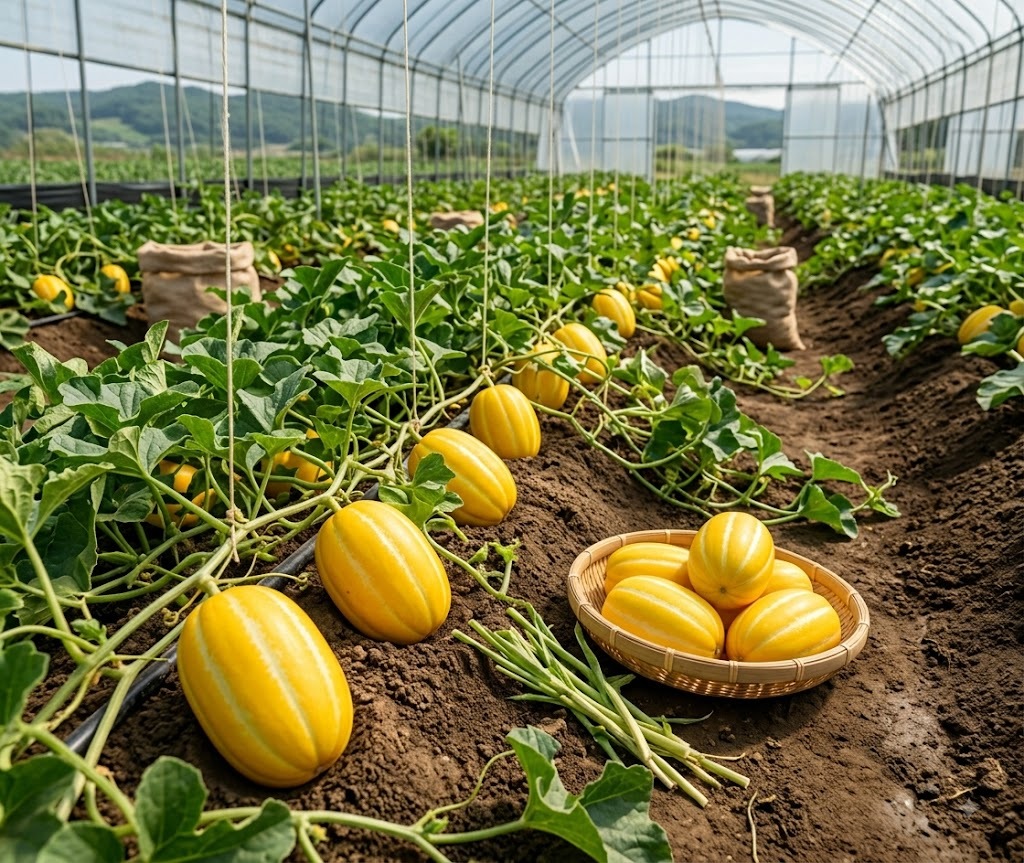
| Item Identity | A fruit and vegetable belonging to the Cucurbitaceae family and the Cucumis melo series. Although botanically very closely related to the melon, it is managed as a separate product crop in the domestic Korean melon industry. |
| Key role | A leading facility-based fruit and vegetable business connecting fresh produce, sorted fruit, gift sets, online sales, school meals, dining out, processing, and export. |
| Harvesting principle | Consider variety, fruit set, skin color, aroma, ripeness, sugar content, fruit firmness, distribution distance, and export conditions together. |
| Product separation | Unripe fruit, marketable fresh fruit, sorted fruit, small fruit, large fruit, raw materials for processing, sliced fruit, juice, puree, and fruit for export are managed as separate products. |
| Separation of similar items | Acknowledging the possibility of overlap with the previous item, Melon, at the Species level, separate into Variety Group, Appearance, Cultivation, Distribution, and Buyer Spec. |
| Domestic statistics | KOSIS manages Korean melon as a crop subject to independent administrative surveys for fruit and vegetable production. The 2025 production figures will be entered after verifying the latest official raw data in accordance with the publication schedule. |
| Concentration in mountainous areas | Based on official announcements from Gyeongsangbuk-do, Seongju accounts for 74% of the national Korean melon production in 2024. |
| Supply and demand risk | Greenhouse cultivation: Energy, weather, water, pollination, pests and diseases, fruit cracking, fermentation, overripening, cold damage, concentration of production areas, price fluctuations |
| Operating Principles | Connect Variety–Facility–Fruit Setting–Harvest–Sorting–Storage–Buyer RFQ to Fruit Lot |
| Final goal | Connecting Korean melons from producers and local organizations with actual distribution, processing, and export buyer specifications, and feeding back evaluation and repurchase results into the next growing season. |
Plant Identity
Basic fields | Korean Melon Registration Standards |
| Korean name | melon |
| English name | Korean melon / Oriental melon |
| Representative scientific name | Cucumis melo L. series |
| classification | Cucurbitaceae · Cucumis |
| Edible parts | Flesh and placenta of mature fruit. Whether the peel and seeds are consumed is classified by product and consumption method. |
| Non-edible · Separate management | Stems, leaves, roots, non-marketable fruit, diseased fruit, sorting by-products |
| Major harvesting stages | Immature fruit / Suitable for distribution / Ripe fruit / For seed collection |
| Basic product form | Fresh fruit · Selected fruit · Small packaging · Gifts · Cut fruit · Processed raw materials |
| Basic processing stage | Harvesting → Sorting → Washing → Pre-cooling/Temperature Control → Packaging → Storage → Cutting/Juicing/Pureing, etc. |
| Basic use | Raw food, retail, online, gift, catering, dining out, processing, export |
| Similarity Principle | Overlap with Melon and Species series is acknowledged, but separated into Product Crop |
The National Institute of Horticultural and Special Crops Science classifies Korean melon as a separate crop within the fruit and vegetable category and manages plant characteristics, environment and growth, growth stages, cultivation methods, variety selection, cultivation techniques, and harvesting and shipping through an independent technical system. ( National Institute of Horticultural and Special Crops Science )
Product Master
Product ID | Product type | Key Management Standards |
| KME-P01 | Korean melons immediately after harvest | Variety · Fruit Set Date · Harvest Date · Ripeness · Lot |
| KME-P02 | Locally Selected Korean Melons | Appearance, weight, size, color, sweetness, defects |
| KME-P03 | Premium Fresh Fruit | Uniformity, Appearance, Sweetness, Packaging |
| KME-P04 | General retail fresh fruit | Grade · Weight · Packaging · Delivery Time |
| KME-P05 | Small Korean melon | Size, specifications, uses, and small packaging |
| KME-P06 | Large Korean melon | Weight · Shape · Texture · Buyer Spec |
| KME-P07 | Gift set | Uniformity, Packaging, Box Size, Brand |
| KME-P08 | For online delivery | Hardness · Buffering · Descent · Delivery Damage |
| KME-P09 | For school meals and dining out | Specifications, Safety, and Delivery Cycle |
| KME-P10 | Fresh fruit for export | Ripness, Hardness, Quarantine, Packaging, Transport Period |
| KME-P11 | Cut Korean melon | Washing, cutting, microorganisms, refrigeration |
| KME-P12 | Refrigerated fruit cups | Cutting Lot · Packaging · Use-by Date |
| KME-P13 | Korean melon juice ingredients | Processing suitability, juice yield, aroma |
| KME-P14 | Korean melon puree | Sweetness, Color, Aroma, Process Lot |
| KME-P15 | frozen ingredients | Pretreatment, rapid freezing, and thawing characteristics |
| KME-P16 | Dried and powdered raw materials | Drying conditions, moisture, color, scent |
| KME-P17 | Non-commercial processed raw materials | Safety, appearance defects, and suitability for processing |
| KME-P18 | Fruit for seed production | Breeds · Self-crossing · Seed Lot |
| KME-P19 | satellite | Variety · Purity · Germination Rate · Seed Lot |
| KME-P20 | finished products | Ingredient content · Manufacturing Lot · Labeling · Use-by date |
Classification criteria | Subdivision type | Management principles |
| Plant classification | Cucumis melo family | Maintaining a Relationship with Melon and Species |
| varieties | Actual Korean melon varieties | Seed/Variety ID required |
| Cultivation type | Forced cultivation, semi-forced cultivation, greenhouse cultivation, etc. | Linking region, planting date, and harvest season |
| Facility type | Vinyl greenhouses, interconnected systems, smart facilities, etc. | Connecting Environment Datasets |
| Harvesting stage | Unripe, moderately ripe, fully ripe | Product Separation |
| Fruit size | Small, Medium, Large and Actual Weight | Buyer Spec |
| quality | Appearance, skin color, grooves, sugar content, firmness, aroma | Measurement by Lot |
| Distribution methods | Bulk · Small Packaging · Gift Sets · Online | Packaging Entity |
| Processing form | Cutting, juicing, pureeing, freezing, drying | Process Lot |
| Final use | Raw food, catering, dining out, export, processing | Buyer RFQ |
| Transaction type | Spot goods, periodic supply, contract, PB, export | Contract Layer |
| origin | Domestic regions, farms, and APCs | Traceability |
step | Essential Dataset | Management purpose |
| Cultivation plan | Variety · Cultivation Type · Facilities · Goals Buyer | Market-based production |
| satellite | Variety · Seed Lot · Germination | Breed Traceability |
| Rootstock and grafting | Rootstock Variety · Grafting Date · Seedling Lot | Disease and Growth Management |
| Seedling cultivation | Sowing, temperature and humidity, seedling age, and growth | Tomb quality |
| Soil and medium | Soil testing, EC, pH, organic matter | Root zone management |
| formula | Official date, number of weeks, density | Crop management |
| survival | Rooting Date · Missing Plant | Early growth |
| Growth management | Stem, number of leaves, vigor, growth | Production forecast |
| Facility Environment | Temperature, Humidity, Solar Radiation, CO₂ | Growth and Diseases |
| Watering | Date · Quantity · EC | Moisture management |
| dispute | Type, Concentration, and Time | Growth and fruit quality |
| Maneuver/Stop | Stem, lateral shoot, fruit-bearing node | Quantity and marketability |
| flowering | Female flowers, male flowers, blooming date | Fruit set prediction |
| pollination | Bees, artificial pollination, fertilization status | Fruit set stability |
| Fruit set | Fruit set date, number of fruits, fruit set location | Harvest Prediction |
| Excessive negligence | Size, weight, growth | Yield prediction |
| pests | Occurrence, Control, and Chemicals | Quality and Safety |
| Physiological disorders | Heat, fermentation, poor shape, etc. | Product Rate Management |
| Accommodation assessment | Days on fruit, skin color, aroma, sugar content, and firmness | Harvest season |
| harvest | Harvest date, time, and number | Harvest Lot |
| Mountain movement | Harvest → Sorting Station Time | Product temperature control |
| Selection | Appearance, weight, size, defects | Grade |
| Non-destructive screening | If sugar content or internal defects are possible | Quality Data |
| purifying | At the Buyer's Request | Hygiene management |
| Product temperature control | Shipment and storage temperature records | Freshness |
| Pre-cooling | Applicability and Method | Shelf-life |
| packaging | Packaging materials, units, cushioning | Damage during distribution |
| save | Temperature, humidity, and period | Quality maintenance |
| shipment | Buyer · Vehicle · Delivery Date | Delivery |
| cutting | Washing, cutting, and hygiene | Fresh-cut Product |
| Juicing | Input, Yield, Filtration | Juice Product |
| Puree | Crushing, heat treatment, and packaging | Ingredient |
| freezing | Pretreatment and freezing | Organ raw materials |
Quality items | Fresh fruit | Selected and pre-treated products | processed goods | finished product | Public rating |
| Species/Product Crop | essential | succession | succession | tracking | Public |
| varieties | essential | succession | tracking | If necessary | Public/Verified |
| mountainous district | essential | succession | succession | Display/Tracking | Public |
| farmhouse | ID | succession | tracking | - | Verified |
| facilities | House ID | succession | tracking | - | Verified |
| Lot | essential | new | new | Manufacturing Lot | Verified/NDA |
| Official date | record | succession | tracking | - | Verified |
| Fruit setting date | core | succession | tracking | - | Verified |
| Harvest day | core | succession | succession | tracking | Verified |
| Skin color | core | Selection | Raw Material Spec | By product | Member |
| ribs and patterns | check | Selection | - | - | Member |
| form | core | Selection | Raw material standards | If necessary | Member |
| weight | By Fructus/By Grade | core | Batch | By product | Member/Verified |
| size | core | Selection | By use | By product | Member |
| Sweetness | Lot measurement | Selection | Raw material specifications | Product specifications | Verified |
| hardness | Exports and online are important | Selection | Raw material specifications | By product | Verified |
| incense | Accommodation assessment | If necessary | Processed flavor | By product | Member |
| flesh condition | Cutting inspection | Sample | Raw material inspection | By product | Verified |
| Placenta and seed duct | Internal quality | If necessary | Removal/Utilization | - | Verified |
| Heat and | test | Exclusion/Rating | Review of processing feasibility | - | Verified |
| Fermentation | test | exception | Principle of safety review | - | Verified |
| Disease | test | exception | Decision on whether to prohibit food conversion | - | Verified |
| Wounds/Compression | test | Selection | Review for processing | - | Verified |
| alien substance | check | Washing and sorting | Compliance with standards | Compliance with standards | Verified |
| pesticide residues | Lot Inspection | succession | Compliance with standards | Compliance with standards | Verified/NDA |
| microorganism | When fresh fruit is needed | Cut product core | essential | Food standards | Verified/NDA |
| Low temperature damage | Confirm after saving | core | - | - | Verified |
| Bone browning | Key to storage and export | test | - | - | Verified |
| packaging | Shipment unit | Packaging Lot | Product packaging | Final | Member |
| save | Temperature, humidity, and time | essential | By product | By product | Verified |
| Expiration date | The relevant city | cut parts | processed goods | Labeling standards | Member |
| Shipment | record | record | record | record | NDA |
| Returns | record | record | record | record | NDA |
| Claim | Types and Causes | connection | connection | connection | NDA |
| Repurchase | Buyer Connection | connection | connection | connection | NDA |
Lot Master Required Field
Lot ID · Item/Product Type · Scientific Name/Variety · Cultivation Type · Origin/Cultivation Area · Producer · Facility/House ID · Seed Lot · Rootstock/Grafting Info · Planting Date · Flowering Date · Pollination Method · Fruit Set Date · Harvest Date · Ripening Level · Quality Indicators · Sugar Content · Hardness · Weight/Specifications/Grade · Skin Color/Furrows/Shape · Check for Cracking/Fermentation/Diseases/Burning · Pesticide Usage Records · Pesticide Residue/Microbiological Test Report · Post-Harvest Product Temperature · Sorting/Pre-cooling/Storage History · Raw Material Lot · Cutting/Juicing/Puree/Freezing Processing History · Packaging Date · Best Before Date · Shipper · Returns/Claims · Repurchase
Korean production statistics
In KOSIS, Korean melon is an independent item under vegetable production (fruit vegetables), and it is a crop subject to administrative surveys by the Ministry of Agriculture, Food and Rural Affairs. Official statistics on Korean melon production are compiled using cultivated area data from the Agricultural Area Survey and production per 10a surveyed by the Ministry. ( KOSIS )
statistical items | standard |
| National Korean melon cultivation area 2025 | Input after official verification of raw data |
| National Korean melon production per 10a 2025 | Input after official verification of raw data |
| National Korean melon production volume 2025 | Input after official verification of raw data |
| Seongju production share | 74% of 2024 national production , Gyeongsangbuk-do official announcement |
North Gyeongsang Province officially announced that Seongju accounts for 74% of the national Korean melon production as of 2024. This figure demonstrates the high concentration of the Seongju production area within the Korean melon supply chain. ( North Gyeongsang Provincial Government )
Demand Structure
Customers | Purchase criteria | Cooperation opportunities |
| Agricultural Cooperatives and Production Area Distribution Organizations | Variety, Farm, Grade, Shipment Time | Joint selection and joint sales |
| APC | Weight, Appearance, Sweetness, and Sorting Standards | Data Selection |
| wholesale market | Grade, Weight, Shipment Volume, and Time | Shipment control |
| large marts | Standards, Sweetness, Packaging, and Stable Supply | Regular supply |
| online platform | Hardness, Hardness, Delivery Durability | Exclusive packaging |
| Department Store · Premium | Appearance, Uniformity, Brand | Premium Product |
| convenience store | Small packaging, cut, and fruit cups | Fresh-cut |
| School and public meals | Safety, Standards, and Delivery Cycle | local agricultural products |
| institutional meals | Uniformity, cooking convenience, delivery time | Regular procurement |
| Hotels and Restaurants | Sweetness, Aroma, and Specifications | Desserts and Fruits |
| Cafe · Dessert | Flesh, aroma, and processability | Seasonal menu |
| Juice company | Juice yield, aroma, and sweetness | Non-products and utilization |
| HMR and dessert manufacturing | Puree · Cutting · Freezing | Processed raw materials |
| PB | Origin, Variety, Story | Regional PB |
| exporters | Ripness, Hardness, Freshness, Packaging | Production exclusively for export |
| Research Institute | Storage · Cold Damage · Sorting · Smart Farm | PRP |
| Seed company | Variety, Fruit Characteristics, Disease Resistance | Variety Collaboration |
step | Key variables | Operational judgment |
| Seeds and seedlings | Variety, Rootstock, and Seedling Quality | Production starting point |
| Facility production | House · Fruit Set · Crop Conditions | Supply forecast |
| Procurement from production areas | Farm · APC · Grade | Provider Pool |
| harvest | Ripness, Sweetness, Harvest Date | Product life |
| Selection | Weight, Appearance, Sweetness | Buyer Spec |
| packaging | Buffering, Standards, Units | Distribution loss |
| Domestic logistics | Temperature, time, and vibration | Freshness |
| save | Low temperature damage · period | Shelf-life |
| export | Quarantine, Packaging, and Transportation Period | Export Spec |
| process | Cutting · Puree · Juice · Freezing | Reduction in non-product rates |
| RFQ | Quantity, Grade, Delivery Date | Match |
| Repurchase | Returns, Claims, Quality | Repeat trading |
Exports and Trade
Whether the Korean melon falls under the fresh melon category must be verified in the current Customs Service HSK, and the HS is not arbitrarily determined based solely on the domestic product name of the Korean melon.
item | Operating Principles |
| Fresh Korean Melon HS | Input after final verification of current Korea Customs Service HSK detailed item descriptions |
| Major categories of melons | 0807 Series Review |
| Fresh fruit | Separation from processed products |
| Cutting and freezing | HS codes separate by processing state |
| Juice and Puree | Separate food HS |
| satellite | Separate for seed collection and sowing |
| Export volume | Input after verifying raw data from the Korea Customs Service |
| export value | Verified by the same HS and product form |
| exporting country | Verification of official customs data |
| Customs clearance unit price | Check quantity, amount, and product condition |
| Quarantine | Verify target country's import requirements and plant quarantine |
| FTA | Check by HS and Rules of Origin |
| refrigerated logistics | Management of product temperature, ripeness, and transportation time |
| CA Logistics | Applied according to export purpose and testing basis |
Products and processes | Key conditions | RFQ conversion |
| Fresh fruit | Variety, Ripeness, Sweetness, Appearance | Origin RFQ |
| Selection and | Weight, Color, Defects | Retail |
| small packaging | Quantity, Weight, Packaging | Online · Mart |
| Gift set | Premium appearance and uniformity | Department Stores · Private Brands |
| For school meals | Size, Safety, Delivery Time | School Meal RFQ |
| For export | Ripening, Hardness, Packaging, Low Temperature Damage | Export RFQ |
| Cutting and | Washing, cutting, microorganisms | Convenience Stores · HMR |
| Cup fruit | Refrigeration and use-by date | B2C |
| Juicing | Juice yield, color, aroma | Beverage |
| Puree | Sweetness, aroma, and viscosity | Desserts and Sauces |
| frozen fruit flesh | Rapid freezing and thawing characteristics | Processed raw materials |
| Dried Korean Melon | Moisture, color, texture | Snack |
| powder | Particle size, scent, moisture | food materials |
| Non-commercial products and | Food safety compliance | RFQ for processing |
| Selection exclusion department | Separation by defect cause | Product Recovery |
| pericarp | Safety, Ingredients, and Pesticide Residues | Materials Research |
| Seeds and placenta | Food, feed, and extraction possibilities | PRP verification |
| waste | Decay and Disease Division | Compost and waste reduction |
Non-products and principles
We do not convert all non-marketable products into raw materials for processing.
Defective appearance/Substandard → Safety confirmed → Processable
Spoilage/Disease/Fertilization/Uncertain safety → Excluded as food ingredient
Separate into.
PRP — Product Research Profile
PRP ID | Product Research Profile |
| PRP-KME-01 | Korean Melon – Melon Plant/Product Separation System |
| PRP-KME-02 | Variety–Fruit Set–Ripening Mapping |
| PRP-KME-03 | Facility Environment – Growth – Fruit Set Rate |
| PRP-KME-04 | Pollination – Fertilization – Marketable yield |
| PRP-KME-05 | Irrigation · EC – Sugar content · Fruit enlargement |
| PRP-KME-06 | Relationship between harvest ripeness, sugar content, and hardness |
| PRP-KME-07 | Harvest season – Domestic shelf life |
| PRP-KME-08 | Harvest Time – CA Export Quality |
| PRP-KME-09 | Cold Storage – Bone Browning Relationship |
| PRP-KME-10 | Hydrothermal Treatment · MA Packaging – Suppression of Low-Temperature Damage |
| PRP-KME-11 | Origin Selection – Online Return Rate |
| PRP-KME-12 | Non-destructive quality sorting |
| PRP-KME-13 | Non-marketable products – Puree and juice processing yield |
| PRP-KME-14 | Fresh-cut Korean melon microorganisms · Shelf-life |
| PRP-KME-15 | Korean Melon Freezing and Thawing Quality |
| PRP-KME-16 | Utilization of fruit peels and seed by-products |
| PRP-KME-17 | Domestic–Export Buyer Spec Comparison |
| PRP-KME-18 | Buyer Spec–Variety–Harvest AI Match |
first of all | Execution item | Performance indicators |
| 1 | Variety, Cultivation Type, House, Fruit Set Date, Harvest Date, and Lot are mandatory. | Required input rate |
| 2 | Separation of Fresh, Export, Cutting, and Processed Products | Product identification rate |
| 3 | Connecting outdoor conditions, facility temperature and humidity, solar radiation, irrigation, and growth | Environmental data connection rate |
| 4 | Linking the Pollination, Fruit Set, Fruit Enlargement, and Harvest Datasets | Negligence tracking rate |
| 5 | Data conversion of sorting, sugar content, hardness, certificates, and storage history | Quality Lot Completion Rate |
| 6 | Producer–APC–Distributor–Buyer RFQ Connection | Match rate |
| 7 | Video AI measurement of growth and fruit set | Fruit set measurement accuracy |
| 8 | AI pest diagnosis | Early detection rate |
| 9 | AI Size and Color Screening for Negligence Videos | Automatic sorting accuracy |
| 10 | Non-destructive sweetness and internal quality screening | Actual measurement error |
| 11 | Harvest date prediction | Actual harvest date error |
| 12 | Production volume forecast | Yield error per house |
| 13 | Prediction of cold damage risk | Incidence of bone browning |
| 14 | Smart Storage & CA Logistics | Arrival rate |
| 15 | Optimization of parcel packaging | Online damage and return rates |
| 16 | Non-marketable and processed goods match | Food conversion rate |
| 17 | AI Buyer Match | Sample approval rate |
| 18 | Traceability | Finished Product → House Traceability |
| 19 | Repurchase Runtime | Buyer repurchase rate |
Problem group | Problem Definition | Required data |
| Mixing Melon and Entity | Confusion in product structure due to belonging to the same species family | Taxonomy·Product |
| Disconnection of variety information | Lack of connection between seed, production, and quality | Variety·Seed |
| Facility environment deviation | Differences in temperature, humidity, and solar radiation by house | Environment |
| Moisture management | Excessive or insufficient watering affects growth and quality | Irrigation |
| Modification instability | Impact of pollination, weather, and facility environment | Pollination |
| Fruit set deviation | Fruit set, location, and uneven growth | Fruit Set |
| Insufficient growth and yield prediction | Difficulty in predicting shipment volume in advance | Growth·Yield |
| pests | Burden of spread and control within the facility | Pest/Disease |
| Physiological disorders | Heat, fermentation, deformities, and development | Environment·Fruit |
| Sugar content variation | Buyer quality deviation | Brix·Irrigation |
| Difference in maturity | Mixed early and overripe harvests | Harvest Stage |
| Concentration in mountainous areas | High proportion of Seongju impacts regional risk | Regional Supply |
| Concentration of supply during the harvest season | Price, sorting, and logistics burdens | Harvest Forecast |
| Selection deviation | Quality evaluation based on appearance | Sorting |
| Limitations of internal quality verification | Lack of non-destructive testing | Sensor·Quality |
| Insufficient temperature control | Discontinuity of temperature history after harvest | Temperature |
| Low temperature damage | Bone browning during long-term low-temperature storage | Storage |
| damaged delivery | Damage and breakage when online sales expand | Packaging |
| Lack of specifications for processed raw materials | Lack of standards for safe processing conversion with non-marketables | Processing Spec |
| Non-products and waste | Insufficient recovery of value from non-products | By-product |
| Export maturity discrepancy | Domestic sales maturity and export conditions differ | Export Quality |
| Lack of CA application information | Optimization of harvest time and transportation conditions is necessary | CA Dataset |
| export logistics costs | Air and Ship Cost Gap | Logistics |
| Discontinuation of test reports | Dispersion of safety information among farms, APCs, and buyers | COA |
| Discrepancy between contract farming and shipment | Difference between planned volume and actual volume by grade | Contract |
| Buyer evaluation non-recovery | Returns and claims are not reflected in the next cultivation | Evaluation |
| Insufficient repurchase data | Difficulty in identifying actual repeat buyers | Repurchase |
RFQ Type | Public Registration | Verify/NDA |
| Korean melon procurement from the production area | Variety, Region, Shipment Date | Farm, Volume, Unit Price |
| Fresh fruit sales | Variety, Grade, Region | Stock · Price · Lot |
| Buying fresh fruit | Weight, Sweetness, Grade | Target Price · MOQ |
| Regular supply | Product · Period · Cycle | Actual quantity and unit price |
| contract farming | Variety, Cultivation Type, Region | Area, Estimated Quantity, Price |
| Premium selection and | General Quality Spec | Sugar content, hardness, and sample |
| Online only | Sudokdo·Pajeon | Return rate and packaging conditions |
| Gift set | Appearance and uniformity | Unit Price · Packaging · Delivery Time |
| For school meals | Safety and Standards | Test Reports and Quantity |
| Dining & Hotel | Sweetness and size | Delivery cycle |
| Cup fruit | Fresh-cut style | Microorganisms and expiration dates |
| Juice ingredients | Non-standard safety and | Juice Yield · Price |
| Puree ingredients | Sweetness and aroma | Processing yield |
| frozen ingredients | Preprocessing type | Processing conditions |
| PB | Origin, Variety, Brand | MOQ · Contract |
| local specialties | Seongju and other production areas · Product | Producer/Processor |
| export | Country, Standard, Harvest Maturity | Quarantine, Unit Price, and Quantity |
| CA Logistics | Transport Period · Destination Country | Process, Cost, and Performance |
| Technology demonstration | Smart Farm · Sorting · Storage | Test Dataset |
| Research cooperation | Variety, Growth, Storage, Export | Research data |
| Utilization of by-products | Pericarp, seeds, and non-marketable fruit | Safety and Process |
① Need Products & Materials
Companies and institutions seeking necessary products, agricultural products, raw materials, and processed goods register purchasing demands. Registered requests are utilized to review cooperation with potential suppliers and producers based on the RFQ Intelligence Library.
Process:
RFQ Registration → Supplier/Product Review → Collaboration Connection → Future AI Matching
Register
② We are looking for production and manufacturing partners. (Need Suppliers & Manufacturers)
Register a request to find necessary production and supply partners, ranging from farms and producer organizations to processing companies, OEM, ODM, and private label manufacturers.
Process:
RFQ Registration → Review of Production & Manufacturing Capabilities → Collaboration Connection → Future AI Partner Matching
Register
③ We are looking for domestic and international buyers. (Need Buyers)
Farmers, producer organizations, and manufacturing companies are requesting cooperation with new buyers, such as domestic and international distributors, importers, brand companies, and food service and catering businesses.
Process:
RFQ Registration → Product & Supply Capability Review → Market & Buyer Connection → Future AI Buyer Matching
Register
Contact : mail@markethub.org
Version | Main contents | situation |
| v1.0 | Plant Identity · Melon Relationship · Facility Production · Quality · Fresh Distribution · Processing · Export · RFQ Basic Structure Registration | complete |
| v1.1 | Verification of raw data for 2025 production, region, price, and import/export formulas | expected |
| v2.0 | Detailed quality specifications for Variety, House, Ripness, Sugar Content, Hardness, Online, Fresh-cut, and Export Products | expected |
| v3.0 | Producer–APC–Processing–Distribution–Export–Buyer Verified Container Combination | expected |