

Judgment axis | Key judgment |
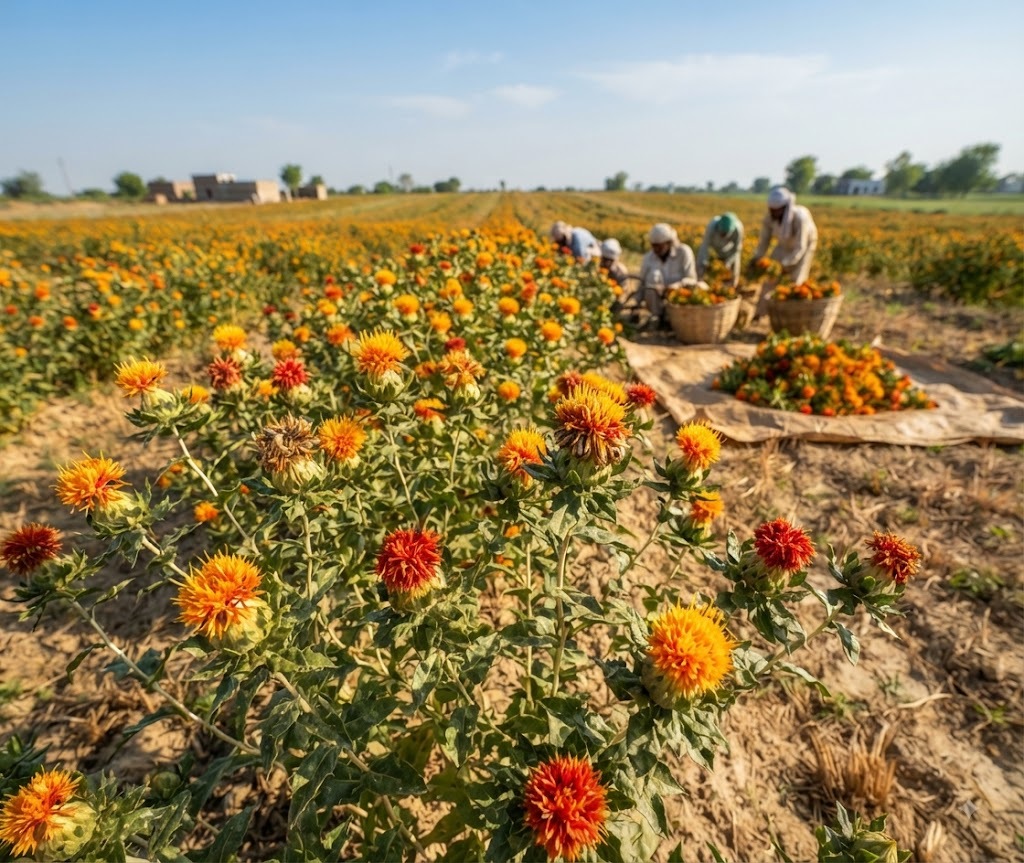
| Item Identity | An oilseed crop of the Asteraceae family that utilizes the seeds of Carthamus tinctorius L. as a raw material for oil and the petals as a separate material. |
| Key role | A dual product structure consisting of safflower seeds → pressing/extraction → safflower oil, and petals → drying/food material. |
| Harvesting principle | Harvesting is based on the flowering stage for petals and on seed maturity, moisture, and fullness for oil. |
| Product separation | Separation of Fresh/Dried Petal·Raw Seed·Cleaned Seed·Crude Oil·Refined Safflower Oil·Meal |
| Separation of similar items | Both sunflowers and oilseeds are different species, Helianthus annuus and Carthamus tinctorius. |
| Domestic food classification | According to official data from the Ministry of Food and Drug Safety, safflower seeds are classified under oilseeds and seeds. ( Ministry of Food and Drug Safety ) |
| Safflower oil classification | According to the Ministry of Food and Drug Safety's food standards data, safflower oil is included as a type of edible oil. ( Ministry of Food and Drug Safety ) |
| Domestic production statistics | South Korea Safflower Sole Cultivation Area · Safflower Seed Production: To be entered after verification of official raw data |
| World production statistics | World production volume of safflower seeds alone based on the latest FAOSTAT 2024 raw data: To be entered after official raw data verification. |
| Crop characteristics | The USDA ARS describes safflower as a representative drought-tolerant oilseed crop. ( ARS ) |
| Ministry of Industry | FAO AGRIS data identifies edible oil demand and drought tolerance as key factors of interest for safflower cultivation. ( FAO AGRIS ) |
| Supply and demand risk | Drought, excessive moisture, diseases, seed yield, oil content, fatty acid profile, harvest loss, storage, import price |
| Operating Principles | Species–Cultivar–Petal/Seed Purpose–Field–Seed Lot–Oil Content–Oil Lot–Buyer RFQ Connection |
| Final goal | Connecting producers, seed sorting, oil extraction and refining, food manufacturing, catering, dining, distribution, and PB buyers all the way to repeat purchases. |
Basic fields | detail |
| Korean name | Safflower |
| English name | Safflower |
| Representative scientific name | Carthamus tinctorius L. |
| classification | Asteraceae, Carthamus genus |
| Edible parts | Mature seeds and seed oil, flower petals as a separate product |
| Non-edible · Separate management | Stems, leaves, roots, seed coats, unsuitable oilseed meal, etc. |
| Major harvesting stages | For petals: Flowering period / For seeds: Seed enlargement → ripening |
| Basic product form | Petals, dried petals, safflower seeds, shelled seeds, powder, crude oil, refined safflower oil, oilseed meal |
| Basic processing stage | Petal harvesting · drying / Threshing · sorting · hulling · pressing · extraction · filtration · purification |
| Basic use | Food materials, tea, pigment materials, edible seeds, edible oil, food manufacturing |
| Principle of similar items | Separation of other oilseeds such as sunflowers and rapeseed, species, and oil products |
The USDA ARS designates safflower as the oilseed crop of Carthamus tinctorius L. Related data from the Ministry of Food and Drug Safety also classifies safflower seeds as oilseed plants and safflower oil as edible oils. ( ARS )
Product Master
Product ID | Actual product form | Key Management Standards |
| SAFFLOWER-P01 | seeds for cultivation | Cultivar · Seed Lot · Germination Rate |
| SAFFLOWER-P02 | Fresh flowers for harvesting petals | Flowering stage, color, and harvesting date |
| SAFFLOWER-P03 | Fresh flower petals | Foreign matter, color, moisture |
| SAFFLOWER-P04 | Dried safflower petals | Moisture, color, foreign matter, drying history |
| SAFFLOWER-P05 | Safflower seeds immediately after harvest | Maturity, moisture, foreign matter |
| SAFFLOWER-P06 | Dried safflower seeds | Moisture content, fullness, and shelf life |
| SAFFLOWER-P07 | Jeongseon safflower seeds | Purity, foreign matter, immature grains |
| SAFFLOWER-P08 | Kernel | Dehulling Yield · Whole/Broken |
| SAFFLOWER-P09 | Safflower seeds for oil extraction | Oil Content · Moisture · Quality |
| SAFFLOWER-P10 | Crude Safflower Oil | Milking Lot · Yield · Quality |
| SAFFLOWER-P11 | Filtered Safflower Oil | Filtration, sedimentation, oxidation |
| SAFFLOWER-P12 | Refined Safflower Oil | Refining History · Edible Oil Standards |
| SAFFLOWER-P13 | High-linoleic type oil | Fatty Acid Profile |
| SAFFLOWER-P14 | High-oleic type oil | Cultivar · Fatty Acid Profile |
| SAFFLOWER-P15 | Safflower seed powder | Particle size, fat, oxidation |
| SAFFLOWER-P16 | Safflower Meal/Cake | Residual oil, moisture, and safety |
| SAFFLOWER-P17 | Food and Private Brand Finished Products | Ingredient Traceability, Labeling, and Use-by Date |
Classification criteria | Subdivision type | Management principles |
| Plant classification | Carthamus tinctorius | Plant Master |
| Cultivar | Purpose of seeds, oils, and petals | Cultivar ID |
| production purpose | Petal·Seed·Oil·Dual-purpose | Use Type |
| Harvesting stage | Flowering period, seed enlargement, ripening | Harvest Stage |
| Edible parts | Petals, seeds, and seed oil | Product Separation |
| Distribution methods | Fresh Petal·Dried Petal·Raw Seed·Cleaned Seed | SKU separation |
| Processing form | Powder·Crude Oil·Refined Oil·Meal | Product ID |
| Yoo Ji-hyung | By Fatty Acid Profile | Oil Attribute |
| Final use | Food Ingredient·Tea·Color Ingredient·Cooking Oil·Food Manufacturing | Buyer Spec |
| Transaction type | Contract farming · Local sourcing · Milking raw materials · Bulk oil · OEM/PB | Verified/NDA |
step | Essential Dataset | Management purpose |
| Cultivation plan | Cultivar · Petal/Seed/Oil Purpose · Area | Production plan |
| satellite | Seed Lot · Germination Rate | breed tracking |
| sowing | Sowing date and density | Production Lot |
| budding | Budding rate · Hair emergence | Early growth |
| Vegetative growth | Plant height, branching, number of leaves | Production forecast |
| rising | Temperature, rainfall, and drought | Crop Risk |
| soil | Soil, Drainage, Moisture | productivity |
| Watering | Soil moisture and irrigation amount | Growth management |
| dispute | Input amount and timing | Production history |
| weeds | Occurrence and Control | quantity protection |
| pests | Occurrence and Control | Production and Quality |
| Flower bud formation | Fire Blossom Basin | Petal/Seed Forecast |
| flowering | Flowering date and stage | Petal Harvest |
| Flower petal collection | Date of collection, color, weight | Petal Lot |
| dried flower petals | Temperature, time, moisture | Food Ingredient |
| Seed formation | Fruitfulness/Fillingness | Yield Forecast |
| enlargement of the royal family | royal status | Oil Yield Forecast |
| Fully ripened | Seed color, moisture, and fullness | Seed Harvest |
| harvest | Date and Method | Harvest Lot |
| threshing grain | Seed Recovery | Yield |
| Jeongseon | Removal of foreign objects and immature grains | Seed Grade |
| dry | moisture | Zhejiang Province |
| save | Temperature and period | Rancidity and quality |
| peeling | Kernel Recovery | Ingredient |
| smash | Island | Powder |
| milking | Input amount · Crude oil amount | Oil Yield |
| percolation | Sediment/Foreign matter | Crude/Filtered Oil |
| tablet | Process · Lot | Food-grade oil |
| packaging | Bulk/Retail | Finished Product |
| shipment | Buyer·Lot | Delivery |
Quality items | Flower petals · Raw material | Safflower seeds | Safflower oil | finished product | Public rating |
| Species | essential | essential | succession | tracking | Public |
| Cultivar | essential | essential | succession | tracking | Verified |
| production purpose | Petal | Seed/Oil | Oil Type | By product | Member |
| mountainous district | essential | essential | succession | mark | Public |
| farmhouse | ID | ID | tracking | tracking | Verified |
| Lot | essential | essential | new | new | Verified/NDA |
| Harvest day | essential | essential | succession | tracking | Verified |
| Flowering stage | core | - | - | - | Verified |
| petal color | core | - | - | By product | Member |
| royal maturity | - | core | Raw material history | - | Verified |
| appearance | Color/Foreign matter | Seed color/damage | - | Product Standards | Member |
| weight | raw materials | raw material | Input and Output | Display amount | Member |
| moisture | Drying core | core | By product | standard | Verified |
| faithful | - | core | Oil Yield Connection | - | Verified |
| immature teeth | - | check | - | - | Verified |
| alien substance | essential | essential | Filtration management | essential | Verified |
| pesticide residues | Legal standards | Legal standards | Raw material inheritance | Product Standards | Verified/NDA |
| microorganism | Dried flower petals are important | Edible Seeds | If necessary | Product Standards | Verified/NDA |
| Oil Content | - | core | Yield connection | - | Verified/NDA |
| Fatty Acid Profile | - | Raw material characteristics | core | core | Verified/NDA |
| Milking yield | - | - | core | Cost linkage | NDA |
| Acid value, peroxide, etc. | - | - | core | Product Standards | Verified/NDA |
| Oxidation stability | Dry storage | Seed storage | core | core | Verified/NDA |
| Processing history | dry | Jeongseon and Heating | Extraction and refining | essential | NDA |
| packaging | dried flower petals | Bulk | Tank/Bottle | Labeling packaging | Member |
| Expiration date | By product | By product | By product | mark | Verified |
| Shipment | record | record | record | record | Verified |
| Returns and Claims | record | record | record | record | NDA |
| Repurchase | connection | connection | connection | connection | NDA |
Official data from the Ministry of Food and Drug Safety confirms that safflower seeds are classified as seeds and oilseeds , while safflower oil is classified as edible oils. For the actual Lot conformity assessment, the latest Food Code and pesticide residue standards at the time of registration are applied. ( Ministry of Food and Drug Safety )
Lot Master Required Field
Lot ID · Item · Product Type · Species · Scientific Name · Cultivar · Petal/Seed/Oil Production Purpose · Cultivation Type · Origin · Cultivation Area · Producer · Seed Lot · Sowing Date · Flowering Date · Petal Harvest Date · Petal Color · Moisture · Drying History · Seed Maturity Date · Seed Harvest Date · Seed Weight · Size · Fullness · Grade · Pests · Appearance · Pesticide Use Records · Pesticide Residue · Microbial Report · Drying · Sorting · Storage History · Oil Content · Fatty Acid Profile · Raw Material Lot · Shelling · Crushing History · Crushing Lot · Extraction Date · Extraction Yield · Crude Oil Lot · Filtration · Refining History · Refined Oil Lot · Oil Quality Report · Packaging Date · Expiration Date · Shipper · Returns · Claims · Repurchase
Customers | Purchase criteria | Cooperation opportunities |
| Safflower cultivation farms | Cultivar·Petal/Seed Purpose | contract farming |
| Agricultural cooperatives and producer organizations | Origin, seed quantity, moisture | Joint shipment |
| Dried flower petal processing company | Color, moisture, foreign matter, pesticide residue | Ingredient RFQ |
| Seed distributors | Moisture content, fullness, and origin | Seed Supply |
| milking company | Oil Content, Moisture, Foreign Matter | Crushing RFQ |
| edible oil manufacturers | Crude/Refined Oil Quality | Bulk Supply |
| Manufacturing of health and general foods | Lawful Raw Materials, Quality, and Labeling | Ingredient |
| Tea and beverage manufacturing | Dried flower petals · specifications | Product Development |
| Confectionery and Bakery | Oil·Seed Powder | Food Ingredient |
| food service companies | Cooking oil specifications and packaging | Foodservice |
| School and public meals | Safety, Country of Origin, Delivery Time | Contract |
| Distribution/Online | Seed, Oil, Petal Product | Commerce |
| PB·OEM | Safflower oil and processed products | Manufacturing |
| Import and export companies | Origin·Product State·HS | Trade RFQ |
| Research Institute | Variety · Oil Profile · Petal Pigment | R&D Pilot |
step | Key variables | Operational judgment |
| Production in the producing region | Cultivar·Petal/Seed Purpose | Domestic Supply |
| Petal harvest | Flowering period, color, dryness | Petal Supply |
| Seed harvest | Moisture content | Oilseed Supply |
| contract farming | Product Type · Estimated Volume | Procurement |
| Selection and storage | Moisture, foreign matter, inventory | Raw Material |
| milking | Oil Content/Yield | Oil Economics |
| tablet | Crude oil quality and yield | Food Oil |
| Import procurement | Seed/Oil·Origin·HS | Supply Balance |
| Domestic distribution | Seed/Petal/Oil | Buyer Allocation |
| delivery | Quality · Certificate · Lead Time | Buyer Service |
| RFQ · Repurchase | Yield · Quality · Price | Supplier Ranking |
Import and export management
item | Management principles |
| Safflower seeds | Check tariff codes for edible, oil extraction, and seeds in the current Korea Customs Service HSK. |
| seeds for cultivation | Separation from edible safflower seeds |
| dried flower petals | Check HS by degree of processing and use |
| Crude Safflower Oil | Crude oil status separate HS verification |
| Refined Safflower Oil | Separation of refined oil |
| Safflower Meal | Check HS code separately for oilseed meal |
| Korea's import volume | Input after verification of raw data by the Korea Customs Service for 2025/2026 |
| Korea's export volume | Input after official verification of raw data |
| Revenue | Input after official verification of raw data |
| Major suppliers | Enter after verifying HS, base year, weight, and amount |
| FTA | Check preferential tariff rates by Origin, HS, and processing status |
| Food inspection | Check the latest food standards for safflower seeds, safflower oil, and petals by product |
| Customs clearance unit price | Seed, Petal, Crude Oil, and Refined Oil are produced respectively. |
Products and processes | Key conditions | RFQ conversion |
| Fresh flower | Flowering stage, color, foreign matter | Petal RFQ |
| Fresh flower petals | Date of collection · Moisture | Drying Processor |
| dried flower petals | Color, moisture, foreign matter, microorganisms | Tea/Food Ingredient |
| Raw Seed | Cultivar · Moisture · Maturation | Seed RFQ |
| Cleaned Seed | Purity and fidelity | Oil Processor |
| Hulled Seed | Descarburization Yield · Kernel | Ingredient |
| Seed Powder | Particle size, fat, oxidation | Food Ingredient |
| Oilseed | Oil Content·Profile | Crushing RFQ |
| Crude Safflower Oil | Milking yield and quality | Refinery |
| Filtered Oil | Filtration and oxidation | Food Oil |
| Refined Safflower Oil | Cooking oil standards | Food Manufacturer |
| High-linoleic oil | Fatty Acid Profile | Specialty Oil |
| High-oleic oil | Oleic Profile | Specialty/Frying |
| Press Cake/Meal | Residual oil content and safety | Feed/Ingredient Verification |
| Seed Hull | Fiber and moisture | Biomass verification |
| Selected items | Causes and safety | Food/Non-food determination |
Claims of specific functional, medicinal, or cosmetic efficacy derived from flower petals are added to the Product Research Profile only when separate official research or legal grounds for the ingredients are confirmed. This Food Plant Container is limited to focusing on food materials, color, dryness, and quality.
Product Research Profile (PRP)
PRP area | Key question |
| Cultivar | Which market is suitable among petals, seeds, and oil? |
| Dryness | What is the actual level of production stability under dry conditions? |
| flowering | How does the timing of petal harvesting affect color and quantity? |
| petal | How well does it maintain color, moisture, and quality after drying? |
| Seed Yield | What is the yield of edible and oilseed seeds per unit area? |
| Seed Quality | Do the grains, moisture, and foreign matter meet the Buyer's Spec? |
| Oil Content | What is the actual oil production potential per kg of seed? |
| Fatty Acid | How do oil profiles differ by cultivar? |
| peeling | What is the cost-effectiveness of Kernel Recovery? |
| Crushing | What is the crude oil yield relative to the seed input? |
| Refining | What is the change in yield and quality from Crude to Refined? |
| Storage | What is the oxidation stability of seed powder and oil? |
| By-product | Can Meal and Hull be legally utilized for high-value purposes? |
| Buyer | What are the effects of oil profile, color, safety, and delivery time on repurchase? |
first of all | Execution item | Performance indicators |
| 1 | Species·Cultivar·Petal/Seed/Oil Purpose·Origin·Harvest Date·Lot made mandatory | Required value completion rate |
| 2 | Separation of Petal·Seed·Powder·Crude·Refined Oil Product | Product identification rate |
| 3 | Linking weather, growth, flowering, seed enlargement, and harvest data | Production history connection rate |
| 4 | Datafication of quality, certificates, drying, extraction, and refining history | Traceability rate |
| 5 | Farm – Petal Processing – Seed Processing – Oil Extraction – Buyer RFQ Connection | RFQ Match Rate |
| 6 | Video AI Blooming Rate and Petal Color Determination | Judgment accuracy |
| 7 | Video AI Seed Fidelity and Foreign Matter Screening | Grade Accuracy |
| 8 | Pest and disease AI diagnosis | Early detection rate |
| 9 | Petal yield prediction | Error compared to performance |
| 10 | Prediction of seed production | Error compared to performance |
| 11 | Harvest timing prediction | Quality conformity rate |
| 12 | Oil Content Prediction | Error compared to Lab |
| 13 | Crushing Yield Prediction | Error compared to the actual |
| 14 | Fatty Acid Profile Product Classification | Classification accuracy |
| 15 | Seed/Oil Oxidation Risk Prediction | Claim rate |
| 16 | Optimization of domestic and imported procurement | Out of Stock Rate · Landed Cost |
| 17 | AI Supplier/Buyer Match | Sample→Contract Conversion Rate |
| 18 | Traceability | Seed Lot → Oil Lot Traceability |
Problem group | Problem Definition | Required data |
| Confusion of names for safflower and safflower | Plant and Product names are mixed | Standard Name |
| Mixed use of petals and seeds | Manage products from different harvest seasons together | Use Type |
| Cultivar mixed | Differences in characteristics for petals, seeds, and oilseeds | Cultivar |
| Lack of domestic production statistics | Difficulty in assessing the scale of the national industry | Area·Production |
| Weather risk | Impact of drought, heavy rainfall, and high temperatures | Climate |
| pests | Decrease in flowering and seed yield | Pest/Disease |
| Petal yield variation | Variation in color and quantity according to flowering stage | Flowering |
| Variation in drying quality | Changes in petal color, moisture, and microorganisms | Drying |
| Variation in seed yield | Productivity fluctuations | Seed Yield |
| immature teeth | Oil content degradation | Maturity |
| Seed moisture variation | Storage and rancidity risks | Moisture |
| Oil content variation | Difference in economic value per kg of Seed | Oil Content |
| Mixed Fatty Acid Profiles | Maintain Product Spec discrepancy | Fatty Acid |
| Variation in milking yield | Changes in actual manufacturing costs | Crushing Yield |
| Dispersion of test reports | Seed and Oil Certificate are unconnected | Certificate |
| Raw material-oil traceability | Cultivar · Difficulty in tracing origin | Relationship |
| Changes in import prices | Changes in domestic competitiveness | Trade Price |
| Lack of by-product utilization | Unrecovered value of Meal·Hull | By-product |
| Exaggerated functional expression | Confusion regarding the legal scope of food and functional ingredients | Evidence/Claim |
| Repurchase not reflected | Buyer evaluations are not fed back to Cultivar farms | Evaluation·Reorder |
RFQ Type | Public Registration | Verify/NDA |
| Safflower contract cultivation | Cultivar · Use · Area | Farms, Area, Quantity, Unit Price |
| Safflower petal supply | Flowering period, drying method, color | Lot · Price |
| Buy dried flower petals | Moisture, color, foreign matter | MOQ · Test Report |
| Safflower seed sales | Origin · Moisture · Grade | Actual quantity/actual unit price |
| Buy safflower seeds | Oil Grade · Moisture · Foreign Matter | MOQ · Price |
| Regular supply | Crop Year · Supply Cycle | Contract volume |
| Seeds for milking | Oil Content·Profile | Crushing Spec |
| Desquamation | Kernel Grade | Hulling Yield |
| powder | Particle size, fat, and moisture | Food Ingredient |
| Crude Oil | Origin·Lot·Oil Profile | Quality Certificate |
| Refined Safflower Oil | Food Grade | Bulk Contract |
| High-oleic oil | Fatty Acid Profile | Specialty Oil |
| For food manufacturing | Quality and Delivery | Regular delivery |
| School meals and dining out | Cooking oil specifications and packaging | Foodservice |
| PB·OEM | Safflower oil and flower petal products | Manufacturing conditions |
| Meal/Cake | Appearance and safety | By-product RFQ |
| export | Seed/Oil/Petal·HS | Contract |
| import | Origin·Product Type | Exporter·Freight |
| Technology demonstration | Cultivation, drying, milking, AI sorting | Pilot |
| Research cooperation | Cultivar·Oil Profile·Petal Color | Dataset·IP |
① Need Products & Materials
Companies and institutions seeking necessary products, agricultural products, raw materials, and processed goods register purchasing demands. Registered requests are utilized to review cooperation with potential suppliers and producers based on the RFQ Intelligence Library.
Process:
RFQ Registration → Supplier/Product Review → Collaboration Connection → Future AI Matching
Register
② We are looking for production and manufacturing partners. (Need Suppliers & Manufacturers)
Register a request to find necessary production and supply partners, ranging from farms and producer organizations to processing companies, OEM, ODM, and private label manufacturers.
Process:
RFQ Registration → Review of Production & Manufacturing Capabilities → Collaboration Connection → Future AI Partner Matching
Register
③ We are looking for domestic and international buyers. (Need Buyers)
Farmers, producer organizations, and manufacturing companies are requesting cooperation with new buyers, such as domestic and international distributors, importers, brand companies, and food service and catering businesses.
Process:
RFQ Registration → Product & Supply Capability Review → Market & Buyer Connection → Future AI Buyer Matching
Register
Contact : mail@markethub.org
Version | Main contents | situation |
| v1.0 | Plant Identity · Petal/Seed Product Separation · Safflower Seed · Safflower Oil · Meal · RFQ Basic Structure Registration | complete |
| v1.1 | Domestic Production Statistics · Cultivar · FAOSTAT · Current HS · Korea Imports & Exports · Verification of 2026 Food Code Raw Data | expected |
| v2.0 | Detailed specifications for petal blooming stage, dry quality, seed yield, oil content, hulling/crushing yield, fatty acid, and oxidation stability | expected |
| v3.0 | Seed Supplier – Farm – Petal Processing – Seed Sorting – Oil Extraction & Refining Company – Importer – Food Manufacturer – Catering/Restaurant/Retail Buyer Verified Container Combination | expected |