


Judgment axis | Key judgment |
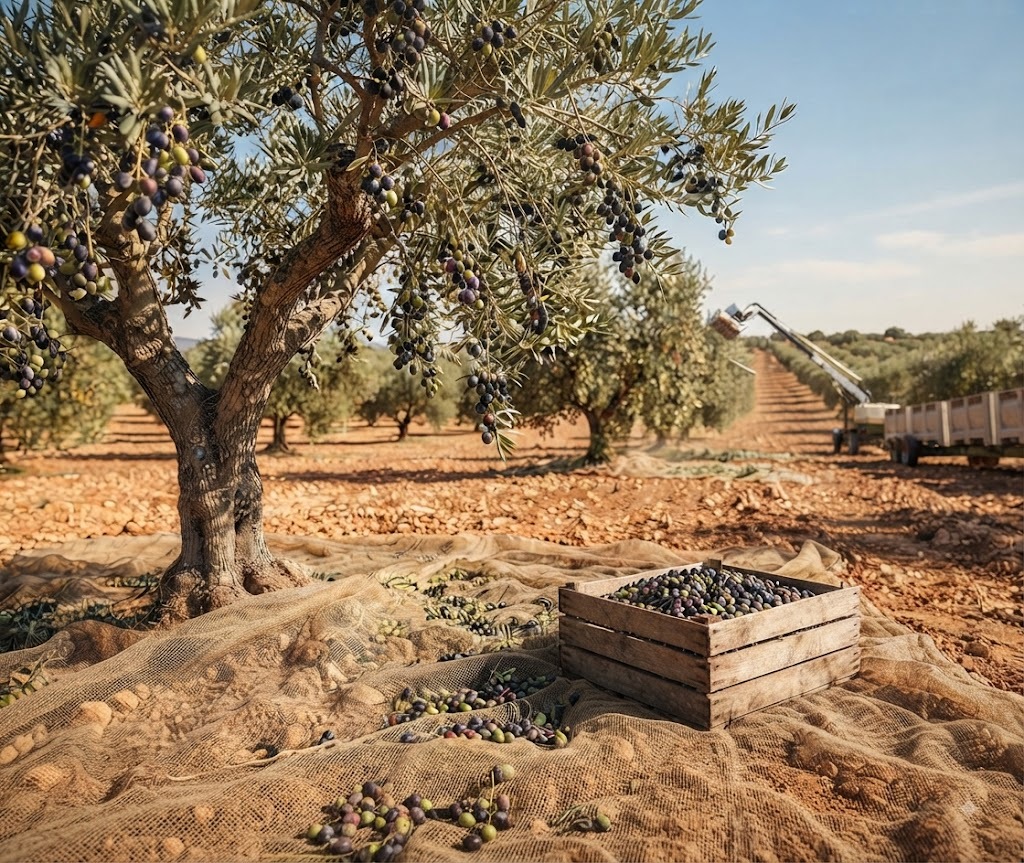
| Item Identity | Olea europaea L. is a representative perennial oilseed tree whose fruits are used for table food or as oil. |
| Key role | Raw materials for Table Olive·Virgin Olive Oil·Extra Virgin Olive Oil·Refined Olive Oil·Olive Pomace Oil |
| Harvesting principle | Connect Cultivar, Usage, Maturity, Harvest Date, Fruit Damage, and Post-Harvest Mill Input Time to Lot |
| Product separation | Fresh Fruit, Table Olive, Virgin Oil, Extra Virgin, Refined Oil, and Olive Pomace Oil are managed as separate products. |
| Separation of similar items | Sunflowers and rapeseed are Seed Oil Crops, while olives are Fruit Oil Crops, so their production and processing runtimes differ. |
| Domestic production statistics | South Korea Commercial Olive Sole Cultivation Area and Fruit Production: To be entered after verification of official raw data. |
| Domestic import | 2025/2026 Imports of Olive Fruit and Olive Oil to Korea: Volume, Value, and Share by Country: Entered after verification of raw data from the Korea Customs Service |
| World olive oil production | The IOC projected global olive oil production for the 2024/25 season at a provisional 3.572 million tonnes and for the 2025/26 season at 3.440 million tonnes . ( International Olive Council ) |
| global consumption | The IOC projected global olive oil consumption for the 2025/26 season to be 3.248 million tonnes . ( International Olive Council ) |
| Market direction | The FAO projected that global olive oil production for 2025/26 would remain largely stable compared to the previous year, suggesting the potential for expanded consumption and trade. ( FAOHome ) |
| Quality Classification | Official EU standards classify categories such as Extra Virgin Olive Oil and Virgin Olive Oil based on acidity, sensory characteristics, etc. ( Agriculture and rural development ) |
| Food safety | Olives (fruit) are managed as an independent agricultural product subject to testing and standards on Food Safety Korea. ( Food Safety Korea ) |
| Supply and demand risk | Climate · Drought · High Temperature · Alternate Bearing · Pests and Diseases · Fruit Damage · Post-Harvest Delay · Oil Yield · Oxidation · International Prices · Maritime Logistics |
| Operating Principles | Cultivar–Orchard–Fruit Lot–Table/Mill Allocation–Oil Lot–Category–Buyer RFQ Connection |
| Final goal | Connecting Producers–Orchards–Table Olive Processors/Mills–Refiners–Importers–Food Manufacturers–Buyers all the way to repurchase |
Basic fields | detail |
| Korean name | olive |
| English name | Olive |
| Representative scientific name | Olea europaea L. |
| classification | Oleaceae, Olea |
| Edible parts | Oil from the whole fruit or flesh |
| Non-edible · Separate management | Seed, Stone/Pit, Leaf, Branch, Pruning By-product, Olive Pomace |
| Major harvesting stages | Green → Turning Color → Ripe/Black → Oil-purpose Harvest |
| Basic product form | Fresh Olive·Table Olive·Virgin Oil·Extra Virgin Oil·Refined Olive Oil·Pomace Oil |
| Basic processing stage | Sorting, pickling, fermentation or washing, crushing, malaxation, separation, storage, purification |
| Basic use | Table Food · Salad · Pizza · HMR · Cooking Oil · Dressing · Sauce · Food Manufacturing |
| Principle of similar items | Table, oil, and dual-purpose cultivars are separated into internal cultivar/use types. |
The olive industry has an industrial structure in which table olives and olive oil are clearly separated. The IOC also manages production, imports, exports, and consumption by product on its statistical platform. ( International Olive Council )
Product Master
Product ID | Actual product form | Key Management Standards |
| OLIVE-P01 | Seedlings for cultivation | Cultivar · Nursery · Rootstock · Soundness |
| OLIVE-P02 | Green Olive Fruit | Cultivar · Size · Color · Hardness |
| OLIVE-P03 | Turning-color Olive | Maturity Index · Damage |
| OLIVE-P04 | Ripe/Black Olive Fruit | Maturity, Appearance, and Flesh Condition |
| OLIVE-P05 | Table Olive Ingredients | Cultivar · Size · Defects · Harvest Date |
| OLIVE-P06 | Green Table Olive | Brine, fermentation, salinity, microorganisms |
| OLIVE-P07 | Black/Ripe Table Olive | Processing Method · Color · Texture |
| OLIVE-P08 | Pitted Olive | Pit removal rate, damage, and filling |
| OLIVE-P09 | Stuffed/Sliced Olive | Filling, cutting, and packaging |
| OLIVE-P10 | Milling Olive | Maturity · Damage · Oil Potential |
| OLIVE-P11 | Virgin Olive Oil | Mechanical Extraction · Lot · Quality Category |
| OLIVE-P12 | Extra Virgin Olive Oil | Chemical · Sensory Standards · Origin |
| OLIVE-P13 | Refined Olive Oil | Refining history, mixing, and quality |
| OLIVE-P14 | Olive Oil Blend | Virgin/Refined Configuration/Display |
| OLIVE-P15 | Olive Pomace | Moisture, residual oil, and uses |
| OLIVE-P16 | Olive Pomace Oil | Extraction, Purification, and Food Suitability |
| OLIVE-P17 | PB · Finished Products | Origin · Category · Lot · Labeling · Use-by date |
Classification criteria | Subdivision type | Management principles |
| Plant classification | Olea europaea | Plant Master |
| Cultivar | Table Oil Dual-purpose | Cultivar ID |
| production purpose | Table Olive Oil Dual | Use Type |
| Fruit ripening | Green·Turning·Ripe | Harvest Stage |
| Fruit size | Buyer Grade | Table Olive Key |
| Distribution methods | Fresh·Brined·Fermented·Pitted·Sliced | Product Separation |
| Maintenance form | Virgin·Extra Virgin·Refined·Pomace | Product Category |
| extraction method | Mechanical, Refined, etc. | Process Separation |
| Packaging type | Bulk Tank·Bottle·Can·Foodservice | SKU |
| Final use | Table·Salad·Pizza·Dressing·Cooking·Frying·Food Manufacturing | Buyer Spec |
| Transaction type | Orchard Contract·Fresh Fruit·Bulk Oil·Import·OEM·PB | Contract NDA |
Since olives are perennial fruit trees, a long-term dataset covering Planting Year–Cultivar–Tree Age–Pruning–Flowering–Fruit Set–Fruit Growth–Maturity–Harvest is required. The FAO proposes an integrated approach to managing the entire production cycle—from pruning and disease control to harvesting, oiling, and storage—to stabilize olive productivity and improve quality. ( FAOHome )
High temperatures and dry conditions caused by climate change are also major production risks. The FAO points out that hotter and drier environments are increasing as risk factors for production systems in the Mediterranean olive-producing region. ( FAOHome )
step | Essential Dataset | Management purpose |
| Production plan | Cultivar · Table/Oil Use · Area | Orchard Planning |
| Seedlings and propagation | Nursery·Cultivar·Rootstock | Plant Traceability |
| Food ingredients | Planting Year · Planting Density | Orchard Master |
| receipt | Tree Age | productivity |
| pruning | Timing, intensity, and crown | Fruit management |
| rising | Temperature, rainfall, drought, frost | Climate Risk |
| Watering | Water source, amount of water, and timing | Fruit/Oil Yield |
| dispute | Materials, Quantity, and Timing | Production history |
| flowering | Flowering date and amount | Crop Forecast |
| moisture | Variety · Weather | Fruit Set |
| Fruit set | Fruit set and fruit drop | Yield Forecast |
| Excessive negligence | Size and flesh ratio | Product Forecast |
| pests | Occurrence and Control | Quality and quantity |
| Maturity assessment | Color · Firmness · Oil Potential | Harvest Allocation |
| harvest | Date and harvesting method | Harvest Lot |
| Origin sorting | Damage, Size, Foreign Object | Table/Mill Allocation |
| purifying | Foreign object removal | Processing |
| Table Olive Processing | Brine, fermentation, and processing | Table Product |
| Mill input | Harvest → Mill Time | Oil Quality |
| Crushing | Fruit Crushing | Paste |
| Malaxation | Time · Temperature · Lot | Oil Separation |
| centrifugation | Oil·Water·Pomace | Oil Yield |
| Virgin Oil Storage | Tank · Temperature · Oxygen · Time | Quality |
| tablet | If necessary | Refined Product |
| Bottling | Bottle/Can | Finished Product |
| Storage and shipment | Tank/Bottle Buyer | Delivery |
Quality items | Fresh/Table Olive | Milling Fruit | Virgin/Refined Oil | finished product | Public rating |
| Species | essential | essential | succession | tracking | Public |
| Cultivar | essential | essential | succession | tracking | Verified |
| Origin | essential | essential | succession | mark | Public |
| Orchard | essential | essential | succession | tracking | Verified |
| Lot | essential | essential | new | new | Verified/NDA |
| Harvest day | essential | essential | succession | tracking | Verified |
| Maturity | core | core | Oil Profile Connection | - | Verified |
| Fruit size | core | reference | - | Table specifications | Member |
| appearance | core | Defect verification | - | Product Standards | Member |
| Damage/Compression | core | core | Quality Connection | - | Verified |
| pests | essential | essential | Raw material history | - | Verified |
| alien substance | essential | essential | percolation | Product Standards | Verified |
| pesticide residues | Legal standards | Legal standards | Raw material traceability | Product Standards | Verified/NDA |
| Fermented brine | core | - | - | Table Products | Verified/NDA |
| microorganism | Table Key | - | If necessary | Product Standards | Verified/NDA |
| Oil Potential | - | core | Yield connection | - | NDA |
| Extraction Yield | - | core | Cost linkage | - | NDA |
| Sando | - | - | Category Core | Product specifications | Verified/NDA |
| Maintenance quality, such as peroxidation | - | - | core | Product specifications | Verified/NDA |
| Sensory evaluation | - | - | Virgin Category Key Points | Label Grade | Verified/NDA |
| Fatty Acid Profile | - | - | core | Spec | Verified |
| Refining history | - | - | Refined required | tracking | NDA |
| Oxidation and light | - | - | Storage Core | core | Verified |
| packaging | For Table | - | Bulk/Tank | Bottle/Can | Member |
| save | brine, refrigeration, etc. | short-term | Tank | By product | Verified |
| Expiration date | By product | - | By product | mark | Verified |
| Shipment | record | record | record | record | Verified |
| Returns and Claims | record | record | record | record | NDA |
| Repurchase | connection | connection | connection | connection | NDA |
The EU distinguishes between Extra Virgin and Virgin Olive Oil categories based on chemical and sensory characteristics. Since "Category" is not merely a marketing term, MarketHub also links Lab Certificates and Sensory/Category Evidence to Product Labels. ( Agriculture and rural development )
In Korea, olives are registered as individual items on the Food Safety Korea website, allowing users to check pesticide residue tolerance standards; additionally, general principles are separately applied when individual standards are unavailable. ( Food Safety Korea )
Lot Master Required Field
Lot ID · Item · Product Type · Species · Scientific Name · Cultivar · Table/Oil/Dual Use · Crop Year · Country · Origin · Orchard · Producer · Tree Age · Cultivation Method · Flowering · Fruit Set · Harvest Date · Maturity · Fruit Weight · Size · Grade · Pests · Damage · Foreign Matter · Pesticide Use History · Pesticide Residue · Microbiological Report · Harvest→Processor History · Table Processing or Milling History · Fruit Lot · Crushing/Malaxation Lot · Extraction Yield · Virgin Oil Lot · Oil Quality (Acidity, Peroxidation, etc.) · Sensory Evaluation · Refining History · Storage Tank · Bottling Date · Expiration Date · Shipper · Returns · Claims · Repurchase
Customers | Purchase criteria | Cooperation opportunities |
| Domestic experimental and commercial cultivation farms | Cultivar · Growth · Fruit Set · Oil Suitability | Regional Pilot |
| Producer organizations in mountainous regions | Cultivar · Harvest · Fruit Lot | Joint shipment |
| Table Olive Importer | Origin · Size · Processing Type | Import RFQ |
| Olive oil importer | Country · Category · Crop Year | Bulk/Bottle Import |
| Cooking oil distributor | Extra Virgin · Refined · Original | Distribution |
| Food manufacturer | Bulk Oil · Quality · Delivery Time | Ingredient |
| Sauce and dressing preparation | EVOO · Refined Oil | B2B |
| Pizza and Bakery | Sliced/Pitted Olive | Regular Supply |
| Salad · HMR | Table Olive Oil | Ingredient |
| Hotels and Restaurants | EVOO·Table Olive | Foodservice |
| School and public meals | Food Safety, Standards, and Country of Origin | Contract |
| Large-scale distribution | Category·Origin·Bottle | Retail |
| PB·OEM | Olive Oil · Table Olive | Manufacturing |
| Premium food brand | Single Origin·Cultivar·Harvest | Premium PRP |
| Research Institute | Domestic Adaptability · Oil Quality | Cultivar Pilot |
| Analysis and inspection agencies | Maintenance quality · Pesticide residues | Validation |
step | Key variables | Operational judgment |
| Orchard production | Country · Cultivar · Crop Year | Supply Forecast |
| Fruit harvest | Maturity, Harvest Date, Damage | Raw Quality |
| Table Allocation | Size·Firmness·Color | Table Market |
| Mill Allocation | Oil Potential · Damage | Oil Market |
| Milling | Harvest Delay·Extraction Yield | EVOO Potential |
| Virgin Oil | Category·Lab·Sensory | Premium Allocation |
| Refining | Raw Oil Category·Yield | Refined Oil |
| Tank Storage | Oxygen, Temperature, Time | Quality Preservation |
| export contract | Origin · Category · Bulk/Bottle | Procurement |
| Maritime logistics | Container · Tank · Transit | Landed Cost |
| Korean customs clearance | HS·Origin·Food Inspection | Import Lot |
| Domestic distribution | Bulk · Bottle · Food Service | Buyer Allocation |
| RFQ · Repurchase | Quality · Category · Claim | Supplier Ranking |
Import and export management
item | Management principles |
| Fresh/Table Olive | Current HSK verification based on preparation status, brine, and fermentation status |
| Virgin Olive Oil | Check the current HS of the Virgin Category |
| Extra Virgin Olive Oil | Check for subdivision in statistical and customs classifications |
| Refined Olive Oil | Separation from Virgin Oil |
| Olive Pomace Oil | Separated from regular olive oil |
| Bulk/Bottled | Separated by HS or trade attributes |
| Korea's import volume | Input after verification of raw data by the Korea Customs Service for 2025/2026 |
| Korean import value | Input after official verification of raw data |
| Major suppliers | Enter after verifying the country, product category, quantity, and amount. |
| FTA | Check Agreement Tariff Rates by Origin, HS, and Product Category |
| Food inspection | Check Table Olive Oil based on separate criteria |
| Customs clearance unit price | Compare only when Category and packaging condition are identical |
| refrigerated logistics | Separate verification in case of fresh fruit imports |
| Oil Logistics | History management by Tank, Flexitank, and Bottle |
Products and processes | Key conditions | RFQ conversion |
| Fresh Olive Fruit | Cultivar · Maturity · Damage | Raw Fruit RFQ |
| Green Table Olive | Size·Firmness·Brine | Foodservice |
| Black/Ripe Olive | Color·Texture | Retail/HMR |
| Pitted Olive | Pit Removal · Whole Rate | Pizza/Salad |
| Sliced Olive | Thickness/Breakage | Food Manufacturer |
| Milling Fruit | Oil Potential · Harvest Delay | Mill RFQ |
| Olive Paste | Crushing · Temperature | Extraction |
| Virgin Oil | Mechanical Extraction | Bulk Oil |
| Extra Virgin Oil | Category·Sensory·Lab | Premium Buyer |
| Refined Olive Oil | Refining History | Food Industry |
| Olive Oil Blend | Configuration and display | Retail/Foodservice |
| Olive Pomace | Moisture and residual oil | By-product |
| Olive Pomace Oil | Extraction, Purification, and Legal Categories | Separate RFQ |
| Pit/Stone | Separation from food | Energy/Material Verification |
| Pruning Residue | Forestry and agricultural by-products | Biomass verification |
| Rejected Fruit | Causes and safety | Food/Non-food determination |
Since the official EU system legally distinguishes between Virgin Olive Oil and Refined/Pomace categories, the RFQ does not combine Extra Virgin, Virgin, Refined, and Pomace into a single price list. ( Agriculture and rural development )
Product Research Profile (PRP)
PRP area | Key question |
| Cultivar | Which use is it suitable for: Table, Oil, or Dual-purpose? |
| Orchard | How do soil, climate, and tree age affect yield and oil quality? |
| Alternate Bearing | How to stabilize year-by-year yield variation |
| climate | How do high temperatures and drought affect fruit and oil yield? |
| maturity | When is the optimal harvesting stage for table olives and oil olives? |
| harvest | What is the impact of machine and manual work on negligent damage? |
| Transport | What is the impact of the Harvest→Mill delay on oil quality? |
| Extraction | What is the actual oil yield relative to kg of fruit? |
| Cultivar Oil | What are the fatty acid and sensory profiles by variety? |
| Virgin Grade | Does it meet category criteria such as Extra Virgin? |
| Sensory | How is the sensory evaluation regarding defects, fruitiness, etc.? |
| Refining | What is the change in yield and quality from crude oil to refined oil? |
| Storage | What are the effects of oxygen, light, and temperature on quality? |
| Table Olive | Are the fermentation, brine, and texture suitable for the Buyer Spec? |
| Buyer | How do Cultivar, Origin, Category, and Quality Affect Repurchase? |
first of all | Execution item | Performance indicators |
| 1 | Cultivar·Orchard·Use Type·Harvest Date·Fruit Lot required | Required value completion rate |
| 2 | Separation of Table Fruit·Milling Fruit·Virgin·EVOO·Refined Product | Product identification rate |
| 3 | Linking weather, flowering, fruit set, fruit enlargement, ripening, and harvest data | Production history connection rate |
| 4 | Datafication of Quality, Certificates, Mills, Tanks, Refining, and Bottling History | Traceability rate |
| 5 | Producer–Mill–Refiner–Importer–Buyer RFQ connection | RFQ Match Rate |
| 6 | Video AI Fruit Maturity Assessment | Maturity assessment accuracy |
| 7 | Video AI Fruit Defect Screening | Defect detection accuracy |
| 8 | Pest and disease AI diagnosis | Early detection rate |
| 9 | Fruit production forecast | Forecast Error |
| 10 | Oil Yield Forecast | Error compared to the actual |
| 11 | Table/Mill Automatic Allocation | Product conformity rate |
| 12 | Harvest-to-Mill Elapsed Time Management | Compliance rate with standard time |
| 13 | Virgin Oil Quality Prediction | Error compared to lab results |
| 14 | Storage Oxidation Risk | Quality claim rate |
| 15 | Crop Year Global Supply Forecast | Supply and demand forecasting accuracy |
| 16 | AI Supplier/Buyer Match | Sample→Contract Conversion Rate |
| 17 | Traceability | Orchard→Bottle traceability |
Problem group | Problem Definition | Required data |
| Mixed Table/Oil Use | Trading identical negligence under the same standards | Use Type |
| Cultivar unmanaged | Differences in Table/Oil suitability by variety not reflected | Cultivar |
| Unclear domestic production base | Need to verify official domestic commercial orchard and production volumes | Domestic Production |
| Alternate Bearing | Variations in fruit yield may occur year after year | Yield History |
| High temperatures and drought | Fruit Yield · Oil Yield Risk | Climate |
| Moisture and fruit set | Fluctuation in fruit number according to flowering conditions | Flowering/Fruit Set |
| pests | Loss of quality and quantity due to fruit | Pest/Disease |
| Mixed maturity | Confusion regarding specifications of Green/Table and Oil fruits | Maturity |
| Harvest damage | Table/Oil quality degradation due to crushing and fruit drop | Damage |
| Harvest→Mill delay | Virgin Oil Quality Degradation Risk | Time Stamp |
| Oil Yield Variation | Change in actual oil recovery amount relative to Fruit kg | Extraction Yield |
| Mixed Category | Confusion regarding EVOO, Virgin, and Refined display | Category Evidence |
| Discontinuation of sensory evaluation | Virgin Grade determination based solely on chemistry test results | Sensory Test |
| Tank mixing | Cultivar·Origin·Lot tracking disconnected | Tank Relationship |
| oxidation | Quality deterioration after storage and bottling | Oxidation |
| Table Olive Fermentation Variation | Salinity, Texture, and Microbial Variation | Fermentation |
| International price fluctuations | Crop Year Supply Fluctuation | IOC Market |
| Low value-added by-products | Pomace·Pit value unrecovered | By-product |
| Repurchase not reflected | Buyer quality evaluation not fed back to Orchard Mill | Evaluation·Reorder |
RFQ Type | Public Registration | Verify/NDA |
| Procurement of fresh olives | Cultivar · Table/Oil · Origin | Farm, Volume, Unit Price |
| Table Olive Ingredients | Size·Maturity·Firmness | Lot · Actual Unit Price |
| Milling Olive | Cultivar·Maturity | Oil Potential · Price |
| domestic test cultivation | Cultivar · Region · Receipt | Farms, Area, Quantity |
| contract farming | Table/Oil Purpose | Area, Price, Conditions |
| Green Table Olive | Size · Brine Type | MOQ · Test Report |
| Black/Ripe Olive | Texture·Color | MOQ · Price |
| Pitted/Sliced Olive | Specifications/Damage | Food Manufacturer |
| Virgin Olive Oil | Origin·Category | Lab Certificate |
| Extra Virgin Olive Oil | Crop Year · Origin · Category | Sensory · Test Report |
| Refined Olive Oil | Quality · Bulk | Contract |
| High-volume food oil | Tank · Delivery Cycle | MOQ · Unit Price |
| Dressing/Sauce | Oil Category | Ingredient |
| Dining Out & School Meals | EVOO/Refined Packaging | Regular Supply |
| PB·OEM | Oil/Table Olive | Manufacturing and bottling conditions |
| Olive Pomace | Moisture and residual oil | By-product |
| import | Origin · Crop Year · Category | Exporter·Freight |
| export | Product·HS·Quality | Contract |
| Technology demonstration | Domestic Cultivar, Mill, and AI screening | Pilot |
| Research cooperation | Adaptability · Oil Yield · Quality | Dataset·IP |
① Need Products & Materials
Companies and institutions seeking necessary products, agricultural products, raw materials, and processed goods register purchasing demands. Registered requests are utilized to review cooperation with potential suppliers and producers based on the RFQ Intelligence Library.
Process:
RFQ Registration → Supplier/Product Review → Collaboration Connection → Future AI Matching
Register
② We are looking for production and manufacturing partners. (Need Suppliers & Manufacturers)
Register a request to find necessary production and supply partners, ranging from farms and producer organizations to processing companies, OEM, ODM, and Private Label manufacturers.
Process:
RFQ Registration → Review of Production & Manufacturing Capabilities → Collaboration Connection → Future AI Partner Matching
Register
③ We are looking for domestic and international buyers. (Need Buyers)
Farmers, producer organizations, and manufacturing companies are requesting cooperation with new buyers, such as domestic and international distributors, importers, brand companies, and food service and catering businesses.
Process:
RFQ Registration → Product & Supply Capability Review → Market & Buyer Connection → Future AI Buyer Matching
Register
Contact : mail@markethub.org
Version | Main contents | situation |
| v1.0 | Plant Identity · Table/Oil Use Separation · Fruit · Virgin · EVOO · Refined · Pomace · RFQ Basic Structure Registration | complete |
| v1.1 | Domestic Production Statistics · Cultivar · Current HS · Korean Imports · Food Code · IOC Latest Statistical Raw Data Verification | expected |
| v2.0 | Orchard · Maturity · Harvest Delay · Extraction Yield · EVOO Chemistry · Sensory · Table Olive · Tank Storage Specification Subdivision | expected |
| v3.0 | Nursery–Orchard–Producer–Table Processor/Mill–Refiner–Importer–Food Manufacturer–Restaurant/Retail Buyer Verified Container combination | expected |