


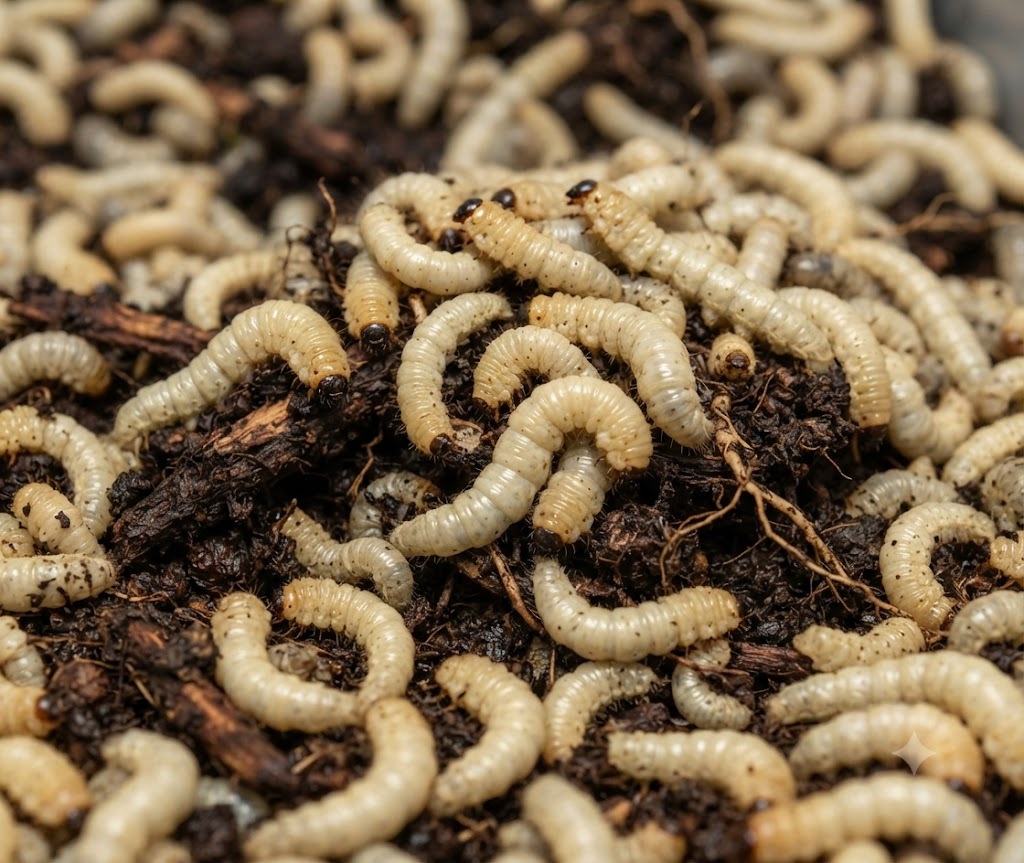
Insects used for Cordyceps production have a different identity from general livestock products. This is because the final product is not the insect itself, but rather fruiting bodies, mycelia, or composite materials obtained by inoculating and culturing specific Cordyceps fungi using insects as hosts . Therefore, it is appropriate to define No. 026 as a Host Insect Production Platform rather than a single insect species.
The Rural Development Administration is disseminating production technology to farms for the actual inoculation and cultivation of Cordyceps fungi in insects, and is conducting research on the production of Cordyceps using hosts such as mealworms and the development of functional materials. The development of food and medicinal materials using insect-derived fungi (Cordyceps) is also included in the work of the National Institute of Agricultural Sciences. ( Rural Development Administration )
Judgment axis | Key points |
| core production unit | Host Insect + Strain + Culture Batch |
| Representative host | Silkworms, mealworms, etc. |
| Main Products | Fruiting body, mycelium, insect-fungus complex raw material |
| production core | Host specifications, strain, inoculation, temperature and humidity, culture period |
| Main ingredients | Cordycepin et al. — Differences by strain and substrate |
| Major risks | Contaminating bacteria, strain confusion, legal scope of raw materials, exaggerated labeling |
| AX | Culture Environment · Imaging · Growth · Contamination · Components Runtime |
| RFQ | Host insects, strains, culture, extraction, functional materials |
| Final goal | Converting insect production into high-value bio-raw materials |
In particular, for this item, both “what insect is it?” and “what strain is it?” must be recorded simultaneously. Even if the host is the same, the final ingredients and product identity will differ if the strain is different; conversely, even if the strain is the same, the results can vary depending on the substrate, such as brown rice, silkworms, or mealworms.
Cordyceps encompasses a biological production system in which insect-parasitic fungi grow on insects or other substrates to form fruiting bodies. Among natural Cordyceps, there are forms that occur on the larvae of the bat moth family, and the National Institute of Agricultural Sciences' Genetic Resources Database lists various host-fungus relationships, such as Cordyceps sinensis and Cordyceps scarabaeicola, which uses adult scarab beetles as hosts. ( Seed Bank )
In industrial production, natural collection and artificial cultivation must be distinguished. MarketHub 026 focuses on artificial cultivation and raw material production using farmed host insects, rather than the trading of natural Cordyceps.
Entity | role | Key Outputs |
| Host Insect | cultured host | Silkworms, mealworms, etc. |
| Fungal Strain | Inoculation strain | Cordyceps strain |
| Inoculated Host | inoculum | culture intermediate |
| Fruiting Body | fruiting body | Functional food ingredients |
| Mycelium | mycelium | Cultured and extracted raw materials |
| Host-Fungus Complex | complex | Dried and powdered raw materials |
| Extract | extract | Functional and bio-materials |
The basic structure is Host Species → Host Stage → Fungal Strain → Inoculation → Cultivation → Product Form → Buyer .
For this item, taxonomy and production protocols are more important than for other livestock species. This is because it is difficult to accurately determine its use as food, raw material, medicine, or bio-use based solely on the common name "Cordyceps."
For example, the Cordyceps referred to in the KFDA’s Herbal Medicine Standards specifies the fruiting bodies and parasites formed by Cordyceps sinensis parasitizing the larvae of the bat moth family. On the other hand, Cordyceps based on silkworms and mealworms used in the industrial field are separate strains and cultured products, so they should not be automatically treated under the same legal or product concepts. (Korea Food and Drug Administration )
division | example | Key Management |
| Host species | silkworm | Species·Stage |
| Host species | brown mealworm | Species·Larva |
| strain | Cordyceps spp. | Strain ID |
| Production type | Insect host culture | Insect-host culture |
| Production type | Grain medium culture | Grain culture |
| product | Fruiting body, mycelium, complex | Product Form |
| use | Food, Functional, and Bio | Legal Status |
MarketHub must manage Host + Strain + Culture Method + Intended Use as a single bundle.
Standardized host insects are required for Cordyceps production. Since variations in host size, growth stage, and health status can lead to inoculation success, culture duration, and final fruiting body productivity, host production must be standardized from the outset.
The next step is strain inoculation and cultivation. At the field briefing held by the Rural Development Administration, methods for producing Cordyceps using insects as hosts and the optimal culture environment were discussed as key technologies. In other words, farm productivity should be viewed not merely as the rearing of host insects, but in the order of inoculation success rate → contamination rate → fruiting body formation rate → final yield . ( Rural Development Administration )
Management area | What the producer should see |
| host | Species, Growth Stage, Weight |
| strain | Strain · Preservation · Vitality |
| inoculation | Method, Concentration, Date |
| culture | Temperature, humidity, light |
| pollution | Bacteria/Defective Batch |
| fruiting body | Formation rate and uniformity |
| harvest | Date/Weight |
| dry | Moisture and temperature |
| expense | Host, Medium, Energy, Labor |
It is appropriate to manage the basic production formula as follows: host insect quantity → inoculation success → fruiting body formation → dry product yield .
Contamination control is more important in Cordyceps production than in general insect farming. Since fungi are intentionally cultured, if molds or bacteria other than the target strain are introduced, the entire product may have to be discarded.
Furthermore, if the final product is used as a food or functional ingredient, the raw material history of the host insect, the strain, and the inoculation, culture, drying, and extraction lots must all be linked. When claiming health benefits, research results must be strictly distinguished from actual recognition or approval.
step | Key Management |
| Host Lot | Species · Feed · Growth Stage |
| Strain Lot | Strain ID · Preservation |
| inoculation | Date·Method |
| culture | Temperature, humidity, and period |
| Contamination test | Germs and bacteria |
| fruiting body | Quantity/Weight |
| dry | Moisture and conditions |
| extraction | Solvent·Yield |
| test | Indicator components and microorganisms |
| circulation | Product Lot · Buyer |
The representative traceability structure is Host Lot → Strain Lot → Inoculation Batch → Culture Batch → Harvest Lot → Processing Lot → Buyer .
In Korea, research and on-farm trials are already underway to expand Cordyceps from a simple cultivation item into a convergence industry linking insects, mushrooms, and functional raw materials . The Rural Development Administration has operated informational sessions for farmers on the practical application of insect-based Cordyceps and conducted joint research with actual production farms. ( Rural Development Administration )
There is also a case where a mealworm farm diversified its products into Cordyceps and obtained a patent. This demonstrates that insect farms can advance a step from the simple sale of raw larvae to Host Insect → Cordyceps Products. ( Rural Development Administration )
Participants | Things needed | RFQ |
| Insect farm | Host insects and sales channels | Host Supply |
| Sericulture farms | Silkworms and production facilities | Host RFQ |
| mushroom farm | Strain and culture technology | Cultivation |
| food companies | Dried/Powdered Raw Materials | Food RFQ |
| functional ingredient company | Standard extract | Ingredient |
| biotech companies | Strains and component materials | Bio-material |
| processing company | Drying and extraction | Processing |
| Research Institute | Strains and Functional | R&D |
| local government | Insect and Bio-industry | Regional AX |
MarketHub separates this market into Host Insect Market + Fungal Culture Market + Functional Ingredient Market .
In the international trade of Cordyceps, regulations should not be judged solely on the name "Cordyceps." Usage conditions may vary by country depending on whether it is a fruiting body or mycelium, an insect host or a grain culture, and whether it is a food or a health functional ingredient.
For example, Taiwan establishes separate usage conditions and labeling standards for the fruiting bodies and mycelia of Cordyceps militaris. This is a good example of how Species/Strain + Product Form + Production Method + Intended Use are mandatory in overseas RFQs. ( Ministry of Food and Drug Safety )
Host Insect → Inoculation/Culture → Fruiting Body/Mycelium → Drying/Powder/Extraction → Inspection → Import/Export → Buyer
Confirmation area | Main contents |
| host | Species · Origin |
| strain | Scientific name · Strain |
| Product form | Fruiting body, mycelium, complex |
| process | Drying, Powder, Extraction |
| food regulations | Scope of Recognized Raw Materials |
| craftiness | Possibility of individual recognition and labeling |
| trade | HS·Customs |
| Buyer | Ingredients, Quantity, Delivery Date |
In the actual RFQ, Host + Fungus + Product Form + Legal Status + Destination Country are verified again.
The value of insects used for Cordyceps production lies more in the components and product forms produced after cultivation than in the host insect itself . These can be divided into dried fruiting bodies, insect-fungus complex powder, extracts, and mycelial raw materials.
Research by the Chungbuk Agricultural Research and Extension Services reported a case in which cordycepin content was measured to be higher in Cordyceps produced using the mealworm as a host compared to that produced in brown rice medium. While this suggests the possibility that host insects influence the component profile of functional ingredients, specific research results should not be generalized to all hosts or strains. ( Rural Development Administration )
Product Entity | Main uses |
| Fruiting Body | Food and raw materials |
| Host-Fungus Powder | Processed raw materials |
| Mycelium | Raw materials and research |
| Extract | Research on functional materials |
| Cordycepin-standardized Material | Review of standardized raw materials |
| Protein/Polysaccharide Fraction | Biomaterials research |
| Residual Biomass | Review of additional utilization |
The key questions regarding PRP are: which substrate among silkworms, mealworms, and grains is advantageous for the target component? Can fruiting body yield and indicator component content be increased simultaneously? What is the processing yield? Can the indicator components and price actually required by the buyer be met ?
Since Cordyceps production requires a consistent environment, the application of AX is highly valuable. By automatically recording the temperature, humidity, light, CO₂, and growth status of each batch in the culture room, delays in fruit body formation or contamination can be detected early.
By analyzing fruiting body density and growth rate using video AI, and linking the host, strain, culture conditions, and final component analysis results, it is possible to learn which conditions produce the best product .
Apply AX | Expected effects |
| Host Batch DB | Host homogenization |
| Strain DB | Strain history |
| environmental sensor | Temperature, Humidity, CO₂, and Light Management |
| Video AI | Fruiting body growth analysis |
| pollution detection | Reduce Batch Loss |
| Harvest forecasting | Production schedule |
| Ingredients Runtime | Comparison of Cordycepin, etc. |
| Buyer Matching | Standardized production |
The core structure is Host + Strain + Environment → Fruiting Performance → Ingredient Profile → Buyer Specification .
The biggest problem in the Cordyceps industry is that all Cordyceps are treated as the same product. When natural Cordyceps, silkworm strains, mealworm strains, grain-cultured Cordyceps, and fruiting bodies or mycelia are mixed together, it becomes impossible to compare research results, market prices, or even their legal status as raw materials.
Furthermore, medical and health efficacy should not be exaggerated merely because research on functional ingredients is active. Since the Ministry of Food and Drug Safety will continue to operate separate procedures and standards for the recognition of functional ingredients in health functional foods in 2026, functionality at the research stage must be separated from official recognition of functionality. ( Ministry of Food and Drug Safety )
problem | Verification data |
| Host variation | Species, weight, growth |
| Strain confusion | Scientific name · Strain |
| Vaccination failure | Vaccination Rate and Method |
| pollution | Bacteria and waste rate |
| Fruiting body variation | Culture environment |
| component deviation | Cordycepin, etc. |
| Processing yield | Drying and extraction |
| Legal scope | Food, health supplements, medicinal |
| Buyer shortage | Specifications · Monthly Demand |
| Exaggeration of efficacy | Distinction between research and licensing |
The basic solution structure is classification accuracy → standard culture → component analysis → legal verification → Buyer Test → contract production .
In RFQ 026, it is necessary to view insect farms and mushroom and fungus cultivation companies separately. This is because the ability to produce host insects well and the ability to stably inoculate and culture strains are different Factory Capabilities.
Therefore, it is advisable for MarketHub to modularly connect host suppliers, strain and culture partners, drying and extraction companies, and food and bio buyers.
RFQ Type | Collaboration Examples |
| Host insect | Silkworms, mealworms, etc. |
| strain | Cordyceps strain |
| inoculation | entrusted culture |
| fruiting body | Drying · Raw materials |
| Composite powder | functional materials |
| extraction | Cordycepin, etc. |
| process | Drying, grinding, and extraction |
| OEM·ODM | Food and raw materials |
| R&D | Host × Strain Comparison |
| AX Pilot | Culture environment and components |
Strain information, culture methods, patents, component analysis, and Buyer Specification are managed at the Verified/NDA stage.
Insects used for Cordyceps production are items that require an RFQ (Request First) . This is because the host, strain, and culture method vary depending on whether the buyer wants Cordyceps militaris, fruiting bodies of mealworm hosts, powder, or standardized Cordycepin extract.
Therefore, rather than a structure where the producer first mass-cultivates Cordyceps and then finds sales channels, production should be designed by working backward from the target product specification.
① Find the host, strain, and raw material.
Need Hosts, Strains & Materials
Companies and institutions seeking host insects such as silkworms and mealworms, culture strains, and fruiting bodies, dried powders, and extract raw materials register their demand. MarketHub reviews suitable suppliers by verifying the host species, growth stage, strain, product form, and ingredient specifications.
RFQ Submission → Host/Strain Specification Review → Supplier Connection → AI Matching
Register
② We are looking for production, cultivation, and processing partners.
Need Cultivation & Processing Partners
We are seeking necessary partners, including insect farms, sericulture farms, mushroom farms, strain culture, drying, extraction, OEM, and ODM companies. Host production capabilities and culture and processing capabilities are evaluated separately.
RFQ Submission → Review of Production & Cultivation Capabilities → Collaboration Connection → AI Partner Matching
Register
③ We are looking for domestic and international buyers.
Need Buyers
Production farms and processing companies seek new buyers, including food, functional ingredient, bio, and research firms. We identify hosts, strains, culture methods, product forms, and ingredients to connect them with suitable purchasing partners.
RFQ Registration → Product & Legal Scope Review → Buyer Connection → AI Buyer Matching
Register
Contact : mail@markethub.org
In the Cordyceps dataset, the Host–Fungus Relationship itself is the core data, rather than the host insect . This is because even with the same mealworm, the results vary depending on which strain is inoculated and at which stage.
Therefore, Host Species and Fungal Strains should be treated as independent entities, and relationships should be established within the Inoculation Batch. By linking culture environment, fruiting body yield, and component analysis to this, the most valuable combination can be found.
Dataset | Simply put |
| Master | Host species, strain, product, and use criteria |
| Entity | Farms · Hosts · Strains · Culture Companies · Buyers |
| Relationship | Host×Strain×Culture |
| Runtime | Growth, Contamination, Yield, Ingredients, Price |
The representative structure is as follows.
Host Species → Host Batch → Fungal Strain → Inoculation Batch → Culture Environment → Fruiting Body → Processing → Ingredient → Buyer
PRP expands as follows.
Host A × Strain 1 vs Host B × Strain 1 vs Grain Medium × Strain 1 → Fruiting body yield → Components such as cordycepin → Processing yield → Selling price
Once this structure is created, it is possible to build a Host–Strain Optimization Dataset rather than simple Cordyceps production.
Source verification for Cordyceps must be stricter than for general livestock species. This is because natural Ophiocordyceps/Cordyceps varieties, silkworm host products, grain-cultured Cordyceps militaris, and insect host experimental products are mixed under the name Cordyceps.
This registration was verified based on the Rural Development Administration's data on the commercialization of insect Cordyceps, the National Biological Resources Database, and the Ministry of Food and Drug Safety's standards regarding herbal medicines and health functional foods. For actual product registration, the status of the food ingredient must be re-verified by strain, host, and product form. ( Rural Development Administration )
Evidence | source |
| A | Rural Development Administration · Ministry of Food and Drug Safety · National Laws · Official DB |
| B | Papers · National Research Institutes |
| C | Patent and Verification Industry Data |
| D | Farm, Business, and Transaction Data |
| E | Additional verification needed |
Key factual basis
- The development of food and pharmaceutical materials using insect-derived fungi (Cordyceps) is specified in the scope of work of the National Institute of Agricultural Sciences . ( Law Information Center )
- The Rural Development Administration conducted a field commercialization project targeting actual farms regarding production methods and culture environments for insect-host Cordyceps. ( Rural Development Administration )
- There are already cases of farms and patents expanding into functional ingredients and processed products by producing Cordyceps using the mealworm as a host. ( Rural Development Administration )
- A specific study by the Chungbuk Agricultural Research and Extension Services found that the cordycepin content of Cordyceps sinensis, a host of the mealworm, was higher compared to that in brown rice medium. This result pertains to a specific host, strain, and process and cannot be generalized to all products. ( Rural Development Administration )
- Dried silkworm cordyceps is listed as a separate food item in the Rural Development Administration's Food Composition Database . ( Rural Development Administration )
- According to the KFDA Standards for Herbal Medicines, Cordyceps sinensis is defined as a specific combination of Cordyceps sinensis and the larvae of the family Malvaceae; therefore, it must not be treated the same as other artificially cultured products. ( Korea Food and Drug Administration )
- Since the Ministry of Food and Drug Safety continues to manage the recognition and standards of functional ingredients for health functional foods through separate notifications in 2026, it must separate functional research results from official recognition of functionality. ( Ministry of Food and Drug Safety )
Version History
Version | Main contents | situation |
| v1.0 | First registration of RFQ structure for host insects, strains, cultures, functionalities, and biotechnology. | complete |
| v1.1 | Subdivision of food ingredients and legal status by host species and strain | expected |
| v2.0 | Host×Strain×Culture·Cordycepin·PRP Runtime Connection | expected |
| v3.0 | Insect Farms · Strains · Culture Companies · Bio Buyer Verified Matching | expected |