


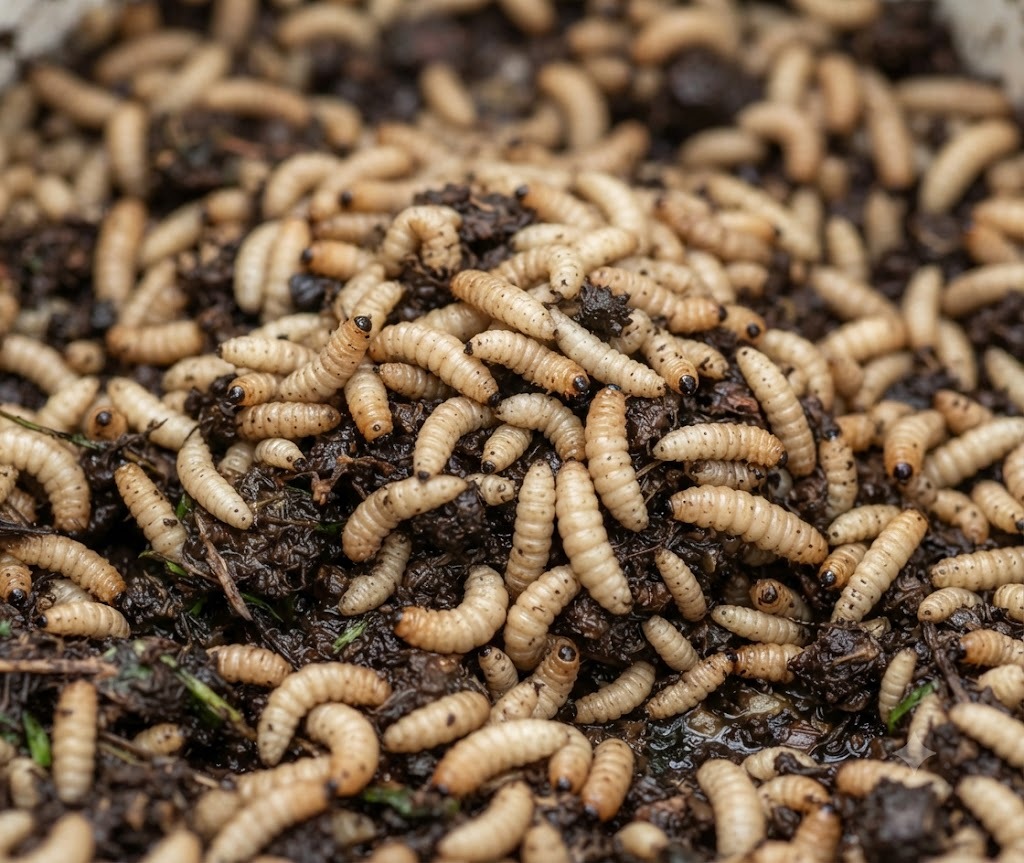
The American black soldier fly is a representative item among industrial insects that directly connects resource recycling with the feed industry . As the larvae grow by consuming various organic raw materials, they produce protein and fat biomass, and the residue remaining after rearing can be utilized as a resource in the form of Fras, thus creating a circular structure of organic by-products → feed raw materials → fertilizer and soil resources.
The FAO has introduced black soldier fly larvae as a promising animal feed resource, and a related 2025 study assessed that BSF larvae possess a dual value in converting organic waste into protein-rich feed ingredients and organic resources. However, in actual industrialization, product safety and regulatory compliance are determined by what by-products are fed and whether those by-products are legally permissible substrates . ( FAOHome )
Judgment axis | Key points |
| Key production stage | larva |
| Main purpose | Feed, Protein, Oils and Fats, Resource Utilization |
| Main Products | Dried larvae, protein powder, insect oil, plastic |
| Major inputs | Permitted feed and organic by-products |
| production core | Egg laying, hatching, larval growth, substrate, temperature and humidity |
| Quality Core | Protein, fat, moisture, contaminants, substrate history |
| Major risks | Non-compliant by-products, heavy metals, microorganisms, regulations |
| AX | Substrate input, biomass, weight loss, harvest, processing yield |
| RFQ | Feed Ingredients, Protein, Oils and Fats, and Resource Utilization Services |
| Final goal | Converting waste costs into industrial raw materials and resource value |
Therefore, the core productivity of the black soldier fly should be viewed not simply as “how many kg of larvae are produced,” but as “how many kg of by-products are input and how much safe protein, oil, and plastic are produced, respectively. ”
The black soldier fly is a Diptera insect that undergoes a life cycle of egg, larva, pupa, and adult. Industrially, the larva is the most important stage, and harvested larvae can be separated into protein powder and insect oil through drying, grinding, and defatting.
Another industrial characteristic is the material remaining after rearing. The mixture of substrate, excrement, and molted skins left behind by the larvae must be managed as a separate Product Entity, and the feasibility of its actual use, such as for fertilizer or soil improvement, must be checked against national regulations.
division | Main purpose | Product Entity |
| Jongchung | breeding | Adult Colony |
| egg | multiplication | Egg Lot |
| larva | biomass | Fresh Larvae |
| dry larva | feedstuff | Dried BSFL |
| Degreased powder | protein | Protein Meal |
| Insect oil | maintain | Insect Oil |
| Fras | resource recovery | Frass |
| Other by-products | subject matter | Chitin-rich Fraction, etc. |
The basic structure is BSF → Life Stage → Substrate → Biomass → Processing → Protein/Oil/Frass → Buyer .
For black soldier flies, it is more important to manage them by separating production purposes and substrates used rather than by breed . The rearing substrate, harvest timing, and processing methods vary depending on whether the goal is to produce protein for animal feed, focus on oil production, or operate as a resource recovery business for specific organic by-products.
The EFSA also explains that the risks associated with insect-derived foods and feed are not determined solely by the insect species, but depend significantly on what was fed, at what life stage it was harvested, and how it was processed. In other words, in the black soldier fly RFQ, "Substrate" is a core field, not supplementary information. ( European Food Safety Authority )
Production type | Key criteria | Major Buyers |
| For protein | Protein, ash, amino acid | feed company |
| Maintenance | Fat content and fatty acid composition | Feed and raw material companies |
| battery larva | Nutrition and Hygiene | feed company |
| For resource recovery | Input substrate, weight reduction, processing speed | Food and agricultural/livestock companies |
| Fras | Nutrition, safety, and legal use | Agriculture and fertilizer companies |
MarketHub designs production in the order of Substrate → Target Product → Processing → Buyer .
In black soldier fly production, stable adult egg laying and egg hatching come first. Subsequently, during the larval stage, substrate moisture, nutritional content, particle size, input density, and temperature and humidity conditions influence growth rate, survival rate, and final yield.
In particular, it should not be understood that any organic by-product can be used as feed. In actual industry practice, only permitted raw materials must be used, and since the growth potential and final nutritional composition of larvae can vary depending on the type of substrate, the input substrates and mixing ratios for each batch must be recorded. A 2025 study on food waste utilization also showed that growth and survival results differed depending on the substrate mixing ratio. ( AGRIS )
Management area | Things to see at a farm |
| Jongchung | Egg laying and adult survival |
| egg | Hatching rate |
| larva | Growth and survival |
| temperament | Type, Mixing, and Input Amount |
| moisture | Substrate moisture status |
| environment | Temperature and humidity |
| harvest | Timing · Live weight |
| Processing efficiency | Input amount · Remaining amount |
| expense | By-products, transportation, energy, labor |
Therefore, it is recommended to manage the basic production formula as follows : input substrate kg → larval body kg + residual Frass kg + moisture and other losses .
Since black soldier flies are used as feed ingredients, safety management takes precedence over the protein content of the final larvae. If the rearing substrate is contaminated, it is necessary to track the raw materials from the point of arrival, as the possibility of heavy metals, residues, and microorganisms entering the final feed system must be examined.
The EFSA explains that chemical contaminants in food and feed may include heavy metals, pesticide residues, and environmental pollutants, and points out that the risks associated with insect feed can also vary depending on production methods and feed sources. ( European Food Safety Authority )
step | Key Management |
| Wearing temperament | Source · Ingredients · Lot |
| breeding | Rearing Batch |
| larva | Survival and Growth |
| harvest | Harvest Lot |
| Inactivation | Heat treatment, etc. |
| dry | Moisture and temperature |
| Degreasing | Oil & Meal Lot |
| test | Proteins, pollutants, and microorganisms |
| circulation | Product Lot · Buyer |
The typical structure is Substrate Lot → Rearing Batch → Harvest Lot → Process Lot → Protein/Oil Lot → Buyer .
In Korea, black soldier flies are viewed more as industrial insects for animal feed and resource recycling than as edible insects . In particular, the oil extracted from the larvae has already established a foundation in Korea for utilizing it as raw feed in the form of insect oil.
The Rural Development Administration explains that it proposed research on the utilization of black soldier fly larvae oil as a policy for the revision of feed standards, and subsequently, insect oil was registered as a raw feed ingredient, opening the way for its use in the feed industry. ( Rural Development Administration )
Participants | Things needed | RFQ |
| Insect farm | Breeder, temperament, and market | Producer |
| feed company | protein powder | Feed RFQ |
| Pet food company | Battery and Dehydrogenated Raw Materials | Pet Feed |
| Aquaculture feed company | Proteins and fats | Aqua Feed |
| food companies | By-product processing | Resource Recovery |
| agricultural and livestock companies | Organic byproduct treatment | Circular RFQ |
| fertilizer company | Fras | Fertilizer Material |
| processing company | Drying and degreasing | Processing |
| local government | Resource Recycling Business | Regional AX |
In other words, the black soldier fly is most significantly different from other industrial insects in that it is an industry where insect farms seek buyers, while simultaneously being an industry where byproduct-emitting companies seek processing partners .
International trade in black soldier flies is highly likely to center on processed products, such as feed protein and insect oil, rather than live flies. Since regulations regarding feed ingredients, animal by-products, and hygiene vary by country depending on the product's intended use and target animal species, the permissible standards of the relevant country must be verified before trading.
Particularly in markets with strict safety assessment and licensing systems for feed products, such as the EU, it is necessary to distinguish whether a product is a feed ingredient or a feed additive. The EFSA clearly stipulates that feed additives must undergo safety and efficacy evaluations and be licensed before market launch. ( European Food Safety Authority )
By-product supplier → BSF rearing → Larvae → Drying/Degreasing → Protein/Oil → Feed company → Livestock/Aquaculture farm
Plus is separate:
BSF Rearing → Frass → Inspection/Processing → Permitted Agricultural Use → Farm
Confirmation area | Main contents |
| protein powder | Protein, ash, moisture |
| Insect oil | fatty acids and rancidity |
| Frass | Nutrition, pollutants, and legal use |
| origin | State/Facility |
| regulation | Distinction between Feed Material and Additive |
| trade | HS·Customs |
| test | Microorganisms, heavy metals, etc. |
| Buyer | Standards · Monthly Demand |
In the actual RFQ, Intended Use + Target Animal + Product Form + Regulatory Status + HS are verified again at the time of transaction.
The industrial value of the black soldier fly lies in the fact that multiple products—protein, fat, and plastic—can be obtained simultaneously from a single rearing cycle . Representative FAO data also evaluates dry BSF as a highly nutritious feed ingredient containing both protein and fat. However, as these figures are based on outdated research, they are utilized only as a benchmark and not as confirmed composition values for farms in 2026. ( FAOHome )
In Korea, insect oil is already available as a feed ingredient, and the Rural Development Administration has researched that black soldier fly larvae oil contains medium-chain fatty acids such as lauric acid. Functional claims should be used by distinguishing between research findings and actual feed effects. ( Rural Development Administration )
Product Entity | Main uses |
| Fresh Larvae | Feed and Processed Raw Materials |
| Dried BSFL | feedstuff |
| Full-fat Meal | Feed protein and fat |
| Defatted Meal | High-protein feed ingredients |
| Insect Oil | Feed oil |
| Frass | Review of Fertilizer and Soil Resources |
| Chitin-rich Fraction | Materials Research |
Key questions regarding PRP include which is more profitable between whole larvae and defatted protein, whether there are sales outlets for insect oil, whether PRP can be a product rather than an actual cost, whether the structure is one where the byproduct supplier bears processing costs or receives raw material costs, and what the total margin is per kg.
Black soldier flies are a product where data-driven management is particularly important. It is impossible to determine resource utilization performance by measuring only the rearing volume; it is essential to simultaneously record the amount of substrate input, larval biomass, plastic, and processing yield .
By utilizing automatic feeding, temperature and humidity management, weight sensors, and video analysis, growth and harvest times for each batch can be predicted. Particularly in byproduct processing businesses, recording real-time input and processing quantities allows insect farms to operate as both production and resource recycling facilities.
Apply AX | Expected effects |
| Temperament wearing DB | By-product tracking |
| Automatic mixing | Temperament standardization |
| environmental sensor | Stable growth environment |
| Automatic weight | Biomass Estimation |
| Video AI | Growth and Density Analysis |
| Harvest forecasting | Production plan |
| Processing yield | Protein/Oil Cost |
| Resource utilization indicators | By-product reduction and conversion analysis |
| Buyer Matching | Sales channels by product |
The core structure is Waste/Substrate Input → BSF Conversion → Biomass → Protein/Oil/Frass → Buyer .
One of the biggest risks in the black soldier fly industry is the simplistic business assumption that feeding waste materials will make money. Not all by-products can be utilized, and if the costs of collection, transportation, pretreatment, and moisture management are high, economic viability may be low even if the cost of raw materials is zero.
Furthermore, changes in substrate can alter growth rate, larval composition, and plastic safety. Therefore, resource circularity performance and feed ingredient quality should not be evaluated separately but must be managed together within a single Problem Bank. The 2025 study also demonstrates that growth and survival outcomes vary depending on the proportion of food waste substrate. ( AGRIS )
problem | Data to verify |
| Temperament inconsistency | Ingredients, Moisture, and Blending |
| Growth retardation | Temperature, humidity, and substrate |
| Decline in survival rate | Environment and pollution |
| Shipping costs | Place of origin/distance |
| Processing fee | Pretreatment · Energy |
| component deviation | Protein·Fat |
| pollution risk | heavy metals and microorganisms |
| Frass sales channels | Standards and legal use |
| Protein price | Soybean meal and fish meal Benchmark |
| Buyer shortage | Monthly demand and specifications |
The basic solution structure is byproduct analysis → pilot rearing → larval yield/reduction rate → component analysis → processing yield → buyer test → economic verification .
The black soldier fly RFQ has more participants than other industrial insects. In addition to RFQs where feed companies seek protein, Resource Recovery RFQs where food and agricultural companies seek byproduct processing methods can exist simultaneously.
Therefore, MarketHub does not connect only the two parties, the Producer and the Buyer. It is appropriate to group the entire Value Chain from the byproduct generating company → BSF operator → protein and oil processing company → feed buyer → Frass buyer into a single Value Chain.
RFQ Type | Collaboration Examples |
| Parent worms and eggs | BSF production |
| larva | Feed and Processing |
| protein powder | Livestock and aquaculture feed |
| Insect oil | Feed oil |
| Frass | Agricultural resources |
| By-product processing | Food and agricultural by-products |
| process | Drying and degreasing |
| OEM | feed ingredients |
| AX Pilot | Resource recovery and cost verification |
| Regional cooperation | Circular Economy Project |
Sensitive information such as substrate composition, processing costs, processing yield, and Buyer unit price is managed at the Verified/NDA stage.
The American black soldier fly is an industrial insect capable of bidirectional RFQ . On one side, feed companies seek protein and insect oil, while on the other, food and agricultural companies look for partners to utilize organic by-products.
Therefore, rather than simply registering an RFQ as "1 ton of black soldier flies needed," you must first distinguish what by-products you intend to process or what feed ingredients you intend to purchase .
① Find feed and raw materials.
Need Feed Ingredients & Materials
Feed, pet food, and aquaculture companies seeking black soldier fly larvae, dried powder, defatted protein, insect oil, etc., register their demand. MarketHub reviews available producers and processing companies by verifying target livestock species, ingredients, processing form, quantity, and delivery conditions.
RFQ Submission → Product Specification Review → Supplier Connection → AI Matching
Register
② We are looking for a partner for byproduct resource utilization.
Need Organic By-product Recovery Partners
Food, agriculture, livestock, and distribution companies are seeking partners to utilize their organic by-products based on black soldier flies. MarketHub reviews the type, composition, quantity, region, legal usability, and economic feasibility of processing by-products.
RFQ Registration → Substrate Conformity Review → Pilot → Resource Recovery Matching
Register
③ We are looking for domestic and international buyers.
Need Buyers
Black soldier fly production and processing companies are seeking new buyers, including feed, pet food, aquaculture feed, and fertilizer companies. Protein, oil, and frasc are separated into distinct product entities and connected with suitable buyers.
RFQ Registration → Supply Capability Review → Buyer Connection → AI Buyer Matching
Register
Contact : mail@markethub.org
The black soldier fly is the most important item among industrial insects in terms of the Relationship Dataset . This is because the quality of the larvae is directly linked to which by-products are fed, and at the same time, the larvae yield is also linked to the by-product processing performance.
Therefore, it is advisable to include Waste Generators and By-product Suppliers as entities, rather than just a simple Farm Dataset. This allows tracking which by-products from which companies were fed into which BSF batches and ultimately converted into which feed products.
Dataset | Simply put |
| Master | BSF, Substrate, and Product Standards |
| Entity | By-product company · Insect farm · Processing company · Buyer |
| Relationship | By-product → Larva → Processing → Product |
| Runtime | Input amount, biomass, yield, price |
The representative structure is as follows.
By-product Supplier → Substrate Lot → BSF Batch → Larval Biomass → Drying/Defatting → Protein + Oil → Feed Buyer
at the same time:
Substrate Lot → BSF Conversion → Frass Lot → Agriculture/Fertilizer Buyer
Economic feasibility is analyzed as follows.
By-product Collection & Processing Revenue – Transportation & Pre-processing Costs + Protein Sales + Insect Oil Sales + Frass Sales – Rearing & Processing Costs = Batch Margin
Given the strong image of black soldier flies as a resource recycling crop, it is important not to exaggerate their environmental benefits. While there is ample research demonstrating the potential to convert organic byproducts into insects, actual carbon reduction, waste reduction, and economic feasibility can vary significantly depending on the substrate, transportation distance, energy consumption, and processing method. Studies for 2025 also point out that safe and economical scaling up is a key condition, alongside this potential for industrialization. ( AGRIS )
This registered version was verified based on FAO data on insect feed, Rural Development Administration data on the use of black soldier fly larvae oil as a feed ingredient, and EFSA's risk assessment on insect food and feed, as well as data on feed safety and contaminant management for 2026. ( FAOHome )
Evidence | source |
| A | Rural Development Administration, FAO, EFSA, Official Government Data |
| B | Papers · Research Institutes |
| C | Verification Industry Data |
| D | Company & Plant Operation Data |
| E | Additional verification needed |
Key factual basis
- The FAO has introduced the Black Soldier Fly as a high-protein, high-fat feed resource and suggested its potential for use in livestock and aquaculture feed. ( FAOHome )
- In the 2025 research review as well, BSF was evaluated as a circular production model capable of converting organic waste into protein feed ingredients and Frass. ( AGRIS )
- Through research by the Rural Development Administration and the revision of related feed standards, an institutional foundation has been established for the utilization of insect oil as a domestic feed ingredient. ( Rural Development Administration )
- Black soldier fly larva oil contains fatty acids such as lauric acid, and its use as a feed ingredient has been studied. However, regarding specific health and antibacterial effects, a distinction must be made between the research stage and actual permitted claims. ( Rural Development Administration )
- EFSA explains that the risks associated with insect-derived foods and feed can vary not only with the insect species but also with the feed substrate, growth stage, and processing method . ( European Food Safety Authority )
- Since food and feed may pose a risk of chemical contamination, such as heavy metals and residues, Substrate Traceability is important in byproduct-based farming. ( European Food Safety Authority )
Version History
Version | Main contents | situation |
| v1.0 | First Registration of RFQ Structure for Resource Utilization of Feed, Protein, Oil, and By-products | complete |
| v1.1 | Detailed application standards for domestically permitted substrates, feed regulations, and Frass | expected |
| v2.0 | Substrate·Conversion Rate·Protein/Oil Yield·PRP Runtime Connection | expected |
| v3.0 | By-product Companies · BSF Producers · Feed · Fertilizer Buyer Verified Matching | expected |